Retail Media Planning
Part of Sponsored product campaigns
Separating brand demand from category discovery
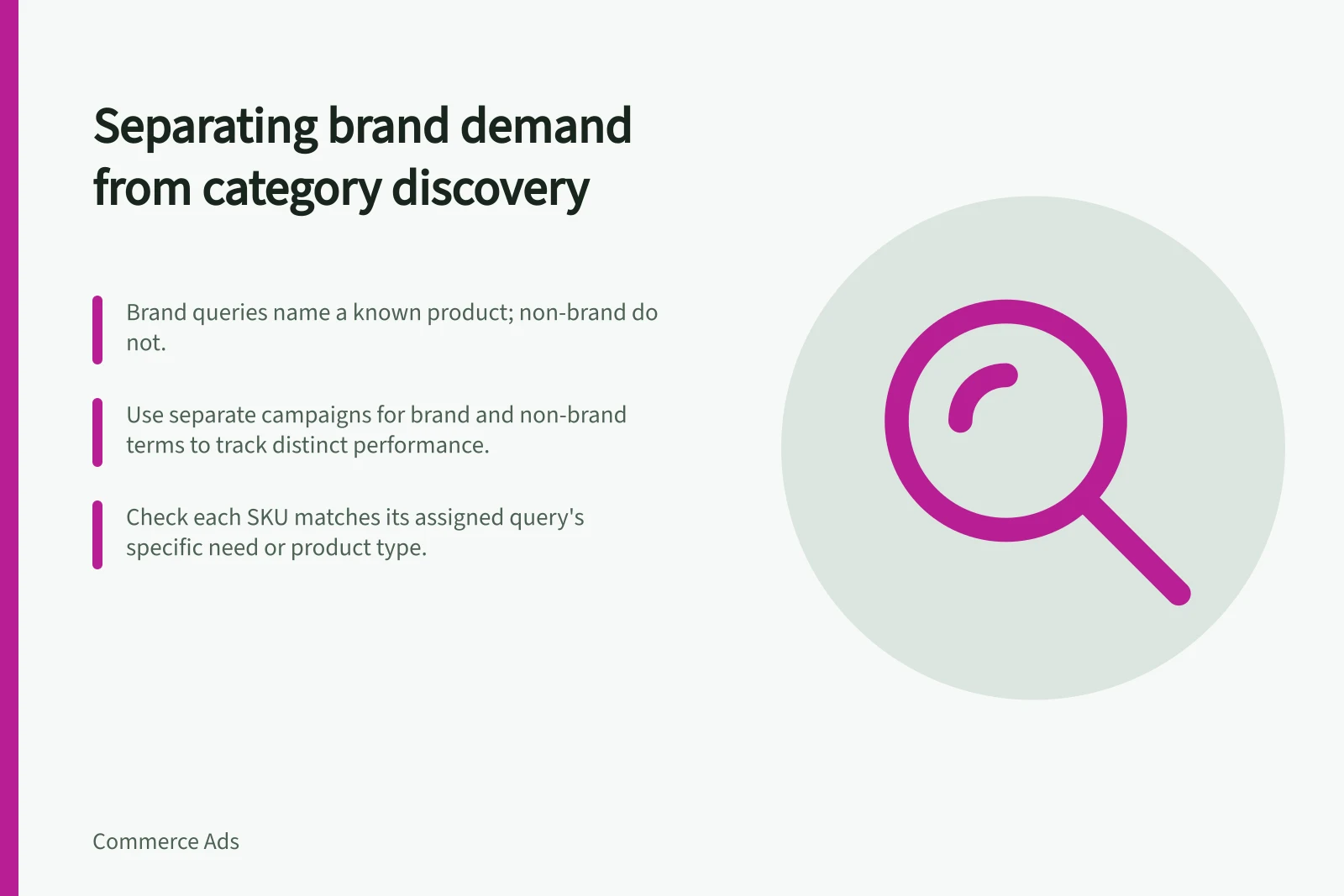
Separate branded searches from category discovery so sponsored product targeting and reporting answer distinct questions.
Separate searches that name your brand from those describing a category, need or feature. Branded queries identify a known name; non-branded do not. Keep targeting and results distinct so sales from branded searches do not obscure what happened on non-brand queries. Neither query type proves motive or whether the advert generated demand.
Classify the search, then check the product
A brand query may contain the brand alone or with an item, size or model. A non-brand query may be broad or very specific. Amazon Ads defines shopping queries as words and phrases customers use to look for products, and keywords as terms bid on in manual campaigns to match those queries. A shopper using a brand term may still compare alternatives; someone using a category term may already know the product.
Create a short map of relevant brand spellings, clearly branded product lines and non-brand descriptions. Set aside ambiguous terms for review rather than forcing them into a group. Check that each advertised SKU answers its assigned query.
| Query group | Planning question | Product check |
|---|---|---|
| Brand or named product | Can the shopper find the item sought? | Exact item, variant and buyability |
| Specific non-brand need | Does the item meet the stated requirement? | Feature, size or compatibility explained |
| Broad category | Is the item a credible option? | Clear product type and useful differences |
Keep each group identifiable
Where the buying system permits, use separate campaigns or reporting groups for brand and non-brand terms, with identifiable products, spend and outcomes. Amazon Sponsored Products documents manual keyword targeting. Nectar360 says clients select terms for Sainsbury’s Search In Grid. Its Search Below Grid matches an advertised SKU’s category to products returned in search; it is not the same term-selected unit.
Amazon also offers automatic targeting, which matches ads with keywords and products similar to the advertised product. Classify the terms actually reported rather than assuming every automatic match served category discovery. If overlapping targeting would make results hard to read, check whether the chosen system permits separate groups or negative targets. Campaign names alone do not make audiences or queries exclusive.
Give each group a purpose. Brand terms may help people locate a known item. Non-brand terms can show whether a product earns attention alongside alternatives. Different query specificity and prior awareness make raw click-through or attributed-sales comparisons insufficient to declare one group better.
State what the result shows
Keep each group’s query definition, promoted products, spend, clicks and the retailer’s stated sales measure. Ask which products and channels count and what attribution window applies.
A sale attributed after a non-brand search is not proof of a new customer or an additional sale caused by the advert. The same caution applies to brand searches. If the business needs a causal answer, use a suitable comparison design. This campaign split makes the two search tasks readable; it is not itself an incrementality test.
Key Metrics for Query Group Analysis
- Query Definition
- Defined by brand or category terms
- Promoted Products
- SKU-specific with clear alignment to query
- Spend
- Separated by campaign group
- Clicks
- Tracked per query group
- Sales Measure
- Retailer-reported attribution window