Incrementality Testing
Measuring commerce advertising
Separate delivery, attributed sales, new-to-brand reporting and incremental outcomes when measuring commerce advertising.
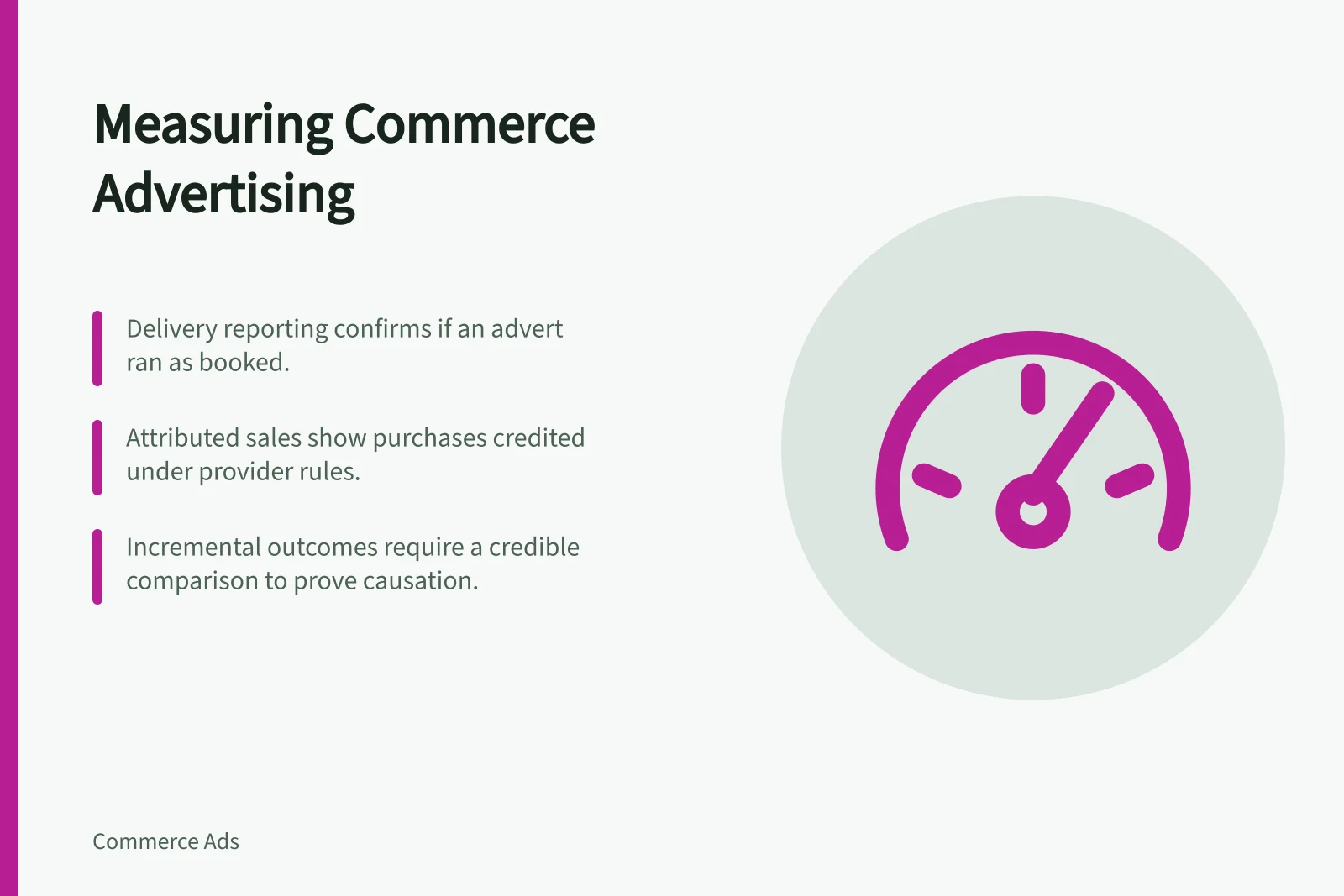
Measure commerce advertising by separating three questions: did the advert run; which sales were credited to it under the provider’s rules; and did it cause additional sales? Delivery reporting answers the first, attribution the second. The third requires a credible comparison with what would have happened without the advertising.
Start with the decision
Set out what the campaign should help you decide before choosing metrics. A launch might need to establish whether the planned media reached shoppers and whether eligible products sold. A decision to increase spend needs stronger evidence that the activity produced additional value. Keep the objective, product set and campaign dates with the final report.
Clicks can prompt a check of the placement or destination. Attributed sales show purchases credited under stated rules. Neither measure alone establishes sales uplift.
Choose measures to match whether the brief is about awareness, acquisition or retention; one KPI may not answer all three. For response measurement, set up unique identifiers such as trackable links, discount codes or promoted product codes before launch. These can improve attribution, but credited sales still do not prove causation.
State whether the intended view covers online activity, in-store activity or both. Bringing online and in-store data together can help show more of the customer journey, while the reported data may still leave gaps between interactions and purchases.
Key Measurement Considerations for Commerce Advertising
- Attribution window
- Varies by platform; define clearly in advance
- New-to-brand definition
- Based on purchase history within defined period; not absolute
- Sales basis
- Gross or net of returns, cancellations, refunds
- In-store vs online data integration
- Helps complete customer journey; may have gaps
Pre-Launch Checklist for Reliable Commerce Advertising Measurement
- Agree on campaign objective and decision context
- Define eligible products, stores, and sales basis (gross/net)
- Set up trackable links, discount codes, or promoted product codes
- Clarify whether online, in-store, or both are included
- Agree on attribution window and credit assignment rules
Read the measurement layers
| Layer | Ask for | What it can establish |
|---|---|---|
| Delivery | Booked placement, spend, dates, reported impressions or plays, clicks and viewability where available | Activity reported as delivered under the seller’s definitions |
| Shopping activity | Destination visits or product-page actions, where available | Measurable steps after the advert, subject to gaps in the reported journey |
| Attributed outcomes | Eligible products, sales channels, sales basis and attribution rules | Purchases credited to advertising under a stated method |
| Incremental outcomes | Defined outcome, credible comparison and uncertainty | An estimate of additional outcomes caused by the campaign within the study’s limits |
An online impression means an advert began to render; it does not establish that someone saw it. In-store, an ad play records that an advert was displayed or rendered on a format. Ask separately how any audience or opportunity-to-see estimate was calculated.
Commerce media sits between brand and performance activity. Fragmented data can make results harder to interpret. A sales report may capture the purchase close to the point of sale without showing which earlier activity helped create demand. Keep the journey represented by each measure clear when reviewing the layers.
Delivery vs. Attribution vs. Incremental Outcomes in Commerce Advertising
- Delivery Layer
- Booked placement, spend, impressions, clicks, viewability
- Shopping Activity Layer
- Destination visits, product-page actions
- Attributed Outcomes Layer
- Eligible products, sales channels, attribution rules
- Incremental Outcomes Layer
- Defined outcome, credible comparison, uncertainty estimate
Compare results with context
At close-out, compare the campaign with relevant historical periods and similar campaigns, and look for patterns that may reflect seasonality. Keep the comparison consistent in the metrics and time periods used. This can help explain variation, but it does not by itself show that advertising caused a sales change.
Define the reported sale
Agree whether sales cover the promoted product and its variants, a wider same-brand category, or both. Record the eligible stores and online transactions. Ask whether sales are gross or net of returns, cancellations and refunds, and when the extract becomes final. A broader product set or longer attribution window can raise a reported total without showing that the campaign became more effective.
Where available, separate outcomes credited after clicks from those credited after views. Record each lookback window and the rule for assigning credit when several adverts qualify.
Keep acquisition and causality distinct
New-to-brand describes a shopper with no qualifying purchase of the specified brand during a defined history period in the available data. It does not establish that the person has never bought the brand elsewhere. That history period is separate from the attribution window between an advert interaction and a purchase.
If the decision depends on additional sales, agree the outcome and comparison before the campaign where possible. Consider differences in price, promotions, stock and other advertising, and ask how uncertainty will be reported. A before-and-after sales change or high attributed return does not supply the missing counterfactual.
A purchase credited to a commerce advert may follow intent built through other activity. Social media, creators, brand advertising and traditional media can all contribute to that journey, so a close-to-purchase sales measure should not automatically be read as the advert’s full contribution.
Pros and Cons of Using Attributed Sales Alone to Assess Campaign Impact
- Pros
- Provides measurable post-ad engagement; useful for reporting and optimisation
- Cons
- Does not prove causation; may include sales from other marketing touchpoints
Record effects beyond immediate sales
Some potential effects are harder to quantify than short-term sales, including first-party data capture, brand positioning and visibility at the point of purchase. Record these objectives in the brief and report what evidence is available for them, rather than treating sales figures as a complete account of campaign performance.
Make a bounded decision
Read the final figures alongside changes in products, price, stock and campaign settings. State what the report supports, what remains unknown and what action follows. If eligible products show attributed sales but no credible causal study is available, report the attribution result and leave incrementality unknown. Keep the measurement definitions with every exported result so later comparisons reveal changes in method.
Use the close-out to record which objectives were measured and which were not, including any intended awareness, acquisition or retention outcomes without available evidence. Keep comparisons and definitions consistent across channels where possible, and note when differences in reporting limit a like-for-like reading. This makes the next campaign brief clearer about what the measurement needs to establish.
Key Steps in Measuring Commerce Advertising Effectiveness
- Define campaign objective and decision context
- Set up unique identifiers (trackable links, codes) before launch
- Separate delivery, attributed sales, and incremental outcomes
- Compare results with historical and similar campaigns
- Record non-sales outcomes (e.g., data capture, brand visibility)
- Make a bounded decisionstate what is supported, unknown, and next steps
In this guide
- Attributed sales versus incremental salesUnderstand what attributed sales count, what incremental sales estimate, and why one figure cannot stand in for the other.