Incrementality Testing
Part of Off-site commerce advertising
Checking whether off-site campaigns add new reach
Assess added off-site reach with a defined comparison set, overlap and frequency, while stating where deduplication is unavailable.
Compare the people exposed to an off-site campaign with those reached by the existing plan over the same period. More impressions or a larger sum of platform reach figures cannot answer that question: the same person may appear in several reports.
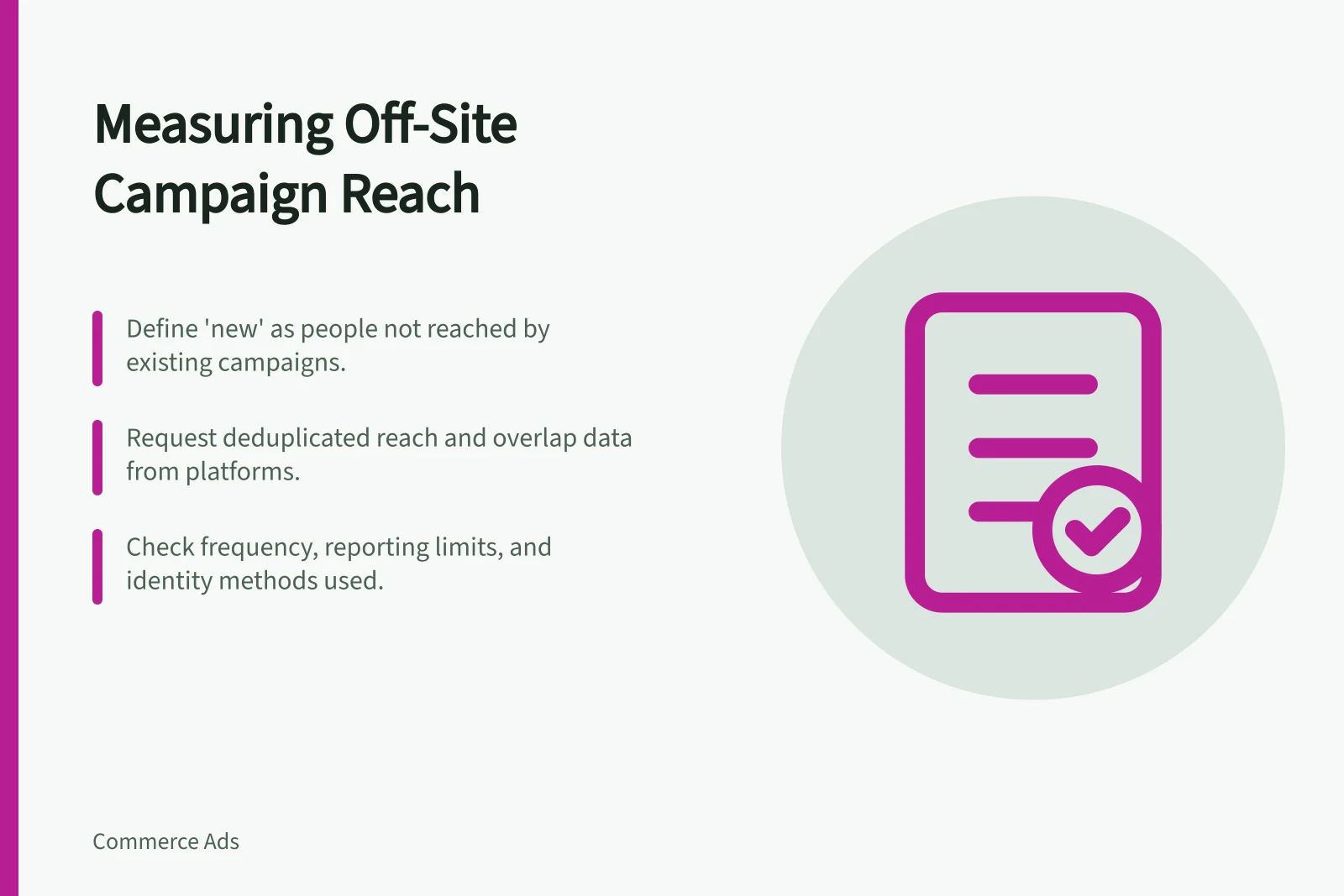
Define ‘new’ before requesting a report
Define ‘new’ before requesting a report
Additional campaign reach means people exposed off site who were not exposed to the other campaigns in the stated comparison set. New reach over time means people first reached in a later day or week of a reporting period. Neither means new customers or additional sales.
Write down the comparison set: for example, the retailer’s on-site adverts, the brand’s existing off-site activity and the proposed campaign. Agree dates, geography and the exposure measure that counts. If the aim is to extend reach beyond one named campaign, do not broaden the finding to all brand advertising.
Defining 'New' Reach: Additional Campaign Reach vs. New Reach Over Time
- Additional Campaign ReachPeople exposed to the new off-site campaign who were not exposed to any other campaigns in the comparison set.
- New Reach Over TimePeople first reached in a later day or week of the reporting period, regardless of prior exposure.
- What It Does Not MeanNew customers or additional sales; these require separate incrementality testing.
Request overlap, not only separate totals
Request overlap, not only separate totals
Ask for deduplicated reach across the combined set and reach exclusive to the new off-site activity. Where both sets use the same population and method, additional campaign reach equals combined reach minus the existing plan’s reach. Keep the conclusion within the activity the reporting system can actually deduplicate.
Google’s documentation includes pages titled ‘Unique Reach Overlap reports’ and ‘Added Reach Measurement for campaigns’. Check the relevant definitions and eligibility before relying on either for this comparison. A platform report should not be treated as deduplicating an unrelated retailer dashboard against another platform’s figures.
If no common measurement is available, show the platform figures separately and say that additional reach is unknown. Adding separate unique-reach totals would overstate combined reach whenever audiences overlap.
Steps to Assess Off-Site Campaign Reach Effectiveness
- Define the comparison setInclude on-site ads, existing off-site activity, and the proposed campaign.
- Agree on dates, geography, and exposure measureEnsure consistency across all platforms and measurement methods.
- Request deduplicated reach and exclusive reachUse platform tools like ‘Unique Reach Overlap reports’ or ‘Added Reach Measurement for campaigns’.
- Avoid combining unrelated dashboardsDo not treat platform reports as equivalent to cross-platform deduplication.
- Report if overlap cannot be determinedIf no common measurement is available, state that additional reach is unknown.
Pros and Cons of Using Platform Reports for Reach Deduplication
- Pros
- Provides reliable deduplicated reach within a single platform; reduces risk of overstatement.
- Cons
- Cannot reliably deduplicate across different platforms; may misrepresent combined reach.
Inspect frequency and reporting limits
Inspect frequency and reporting limits
A campaign can add little exclusive reach while delivering many exposures to people already reached. Request average frequency and, where available, a frequency distribution alongside overlap. If repeated exposure was intentional, judge it against that aim. If expansion was the aim, consider inventory, targeting or frequency controls.
Check the estimate’s limits. Reporting availability, minimum-delivery thresholds, processing delays and maximum reporting windows can vary by metric and platform. Document unavailable rows and reporting delays rather than treating them as zero. Platforms can also use different identity and modelling methods.
Key Metrics to Inspect When Evaluating Off-Site Campaigns
- Average FrequencyMeasure of how often people are exposed to the campaign.
- Frequency DistributionShows how exposures are distributed across audience segments.
- Reporting AvailabilityCheck for minimum delivery thresholds and processing delays.
- Identity and Modelling MethodsDifferent platforms may use distinct identity systems (e.g., Google Signals vs. cookie-based tracking).
State the finding at the right level
State the finding at the right level
A defensible conclusion might be that the campaign added measurable reach within one buying platform, that overlap was high for the selected campaigns, or that cross-platform additional reach could not be established. None establishes sales uplift. If the budget decision depends on sales caused by the media, plan a separate incrementality study with a suitable comparison group.
Checklist for Reporting on Off-Site Campaign Reach
- Confirm the comparison set is clearly definedAvoid broad claims beyond the specific campaigns tested.
- Verify whether deduplication is possibleState if overlap data is unavailable or estimated.
- Report frequency and distribution dataAssess whether repeated exposure was intentional or indicates inefficiency.
- Avoid claiming sales uplift without an incrementality studySales impact requires a controlled experiment with a suitable comparison group.