Retail Media Planning
Retail audience planning
Define shopping signals, recency, exclusions and evidence before buying retailer audiences.
Start retail audience planning with a commercial question, then define the shopping signal that could answer it. A segment label such as “category buyers” is only a starting point. A useful plan states what counted as a purchase, when it happened, who can be reached, the message they will see and how the result will be read.
Key Steps in Retail Audience Planning
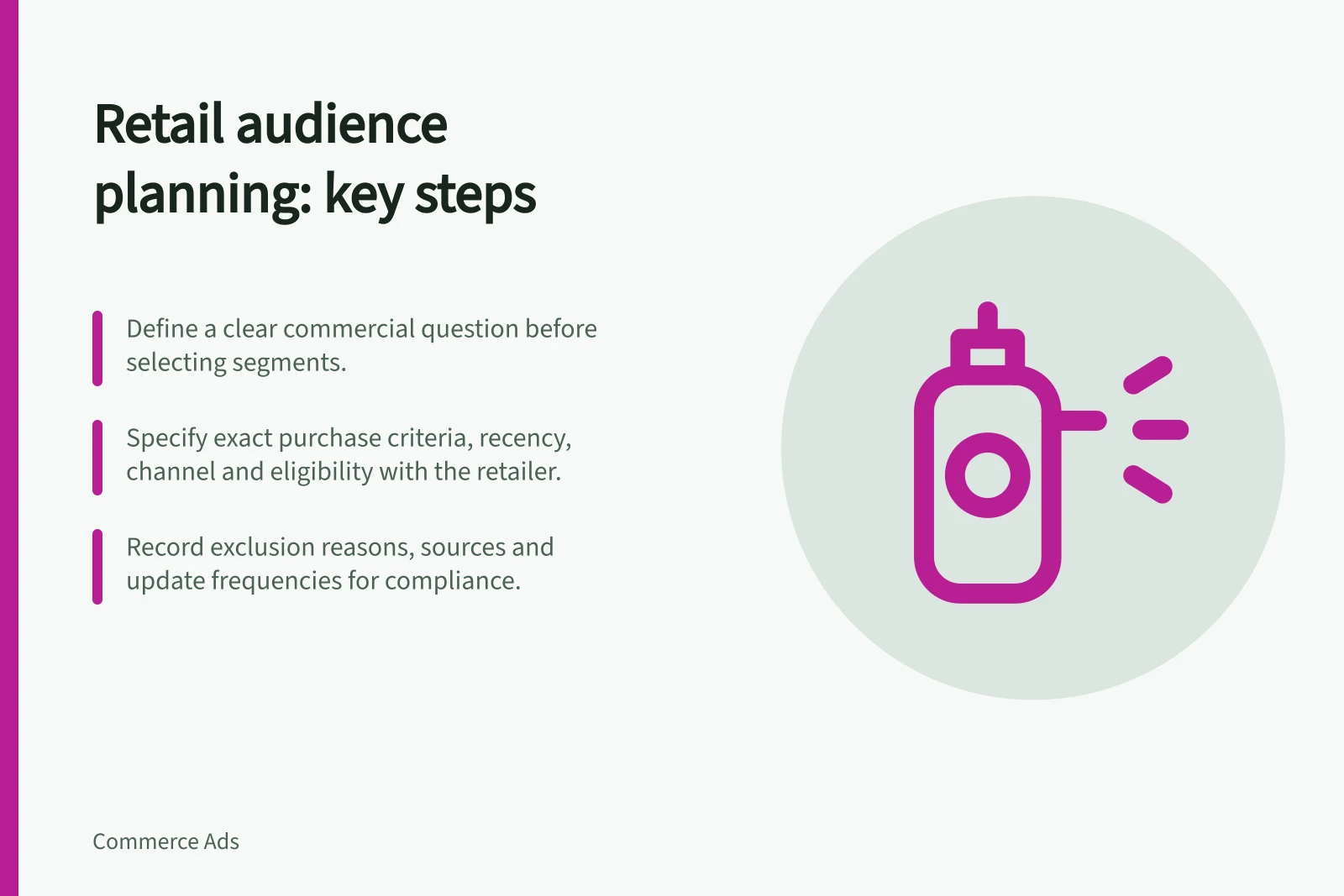
- Define the commercial decisionStart with a clear objective: introduce, re-engage, or support seasonal demand.
- Specify the shopping signalClarify event type, product set, recency window, channel, eligibility and refresh schedule.
- Plan exclusions with justificationInclude legal, preference-based, and commercial exclusions with documented reasons.
- Match creative to evidenceUse messaging appropriate to past behaviour without implying personal knowledge.
- Agree on reporting boundariesDefine what sales attribution means and whether incrementality is measured.
Start with a decision, not a segment menu
Write one sentence stating the decision the campaign must inform. Do you need to introduce a product to category buyers, re-engage previous brand buyers, or support a seasonal need? These are different hypotheses. The first may prioritise relevant reach; the second may depend on time since purchase; the third may depend on availability and timing.
Check the product before buying an audience. Confirm the item is stocked in the retailers, channels and locations included in the campaign. If landing experience or shelf availability is weak, even a well-defined audience may produce poor commercial evidence. Assign someone to monitor assortment changes and stop messages that become inaccurate.
Specify the signal
Retailer shopping signals may include purchases or other documented interactions, but each signal’s availability and meaning vary. Ask the retailer to define the event, product grouping, channel, time window, refresh schedule and treatment of returns. A purchase made months ago is evidence of a past action, not proof of current intention. A category label may hide products with different purchase cycles.
| Field | Example question |
|---|---|
| Event | Was this an observed purchase, a browse action or a modelled classification? |
| Product set | Which SKUs and subcategories qualify? |
| Recency | How far back is the observation, and when is the segment refreshed? |
| Channel | Does the signal cover online, stores or only part of either? |
| Eligibility | What permissions and platform rules allow activation? |
| Scale | What reachable audience remains after exclusions and overlap? |
The answers may be incomplete. Mark unknowns in the brief; do not turn them into inferred facts about individuals.
Compare audiences that represent different needs
Category buyers have shown engagement with a product group, but they may already favour a competitor or not be ready to buy again. Lapsed brand buyers have a prior brand relationship. “Lapsed” only makes sense relative to that product’s normal replacement or repeat cycle.
A recent brand purchaser may be better excluded from an immediate repeat-purchase message, depending on the category. Test these planning hypotheses against the retailer’s actual definitions.
Avoid building ever-narrower segments just because the tools allow it. Splitting by many attributes can reduce reach, complicate comparisons and obscure the original commercial question. Sensitive inferences demand particular care.
The UK Information Commissioner’s Office says profiling for direct marketing must be fair, transparent and supported by a lawful basis; people’s objections must be respected. Have the responsible privacy team assess the proposed use. Do not assume a retailer segment is automatically cleared for every activation.
Comparing Retail Audience Types by Commercial Objective
- Category BuyersEngaged with a product group; may favour competitors or not be ready to repurchase. Best for awareness or range consideration.
- Lapsed Brand BuyersPreviously purchased the brand; timing relative to repeat cycle matters. Suitable for re-engagement campaigns.
- Recent Brand PurchasersMay be excluded from immediate repeat offers depending on category. Risk of message irrelevance if not timed correctly.
Plan exclusions with a reason
Exclusions can protect relevance and prevent unwanted duplication: people who recently bought the promoted item, existing customers already in another campaign, audiences outside available delivery areas, or people whose preferences prohibit the use. These are not one interchangeable category.
A legal or preference-based suppression must follow its own rules. A commercial screening rule is a campaign choice, and its effect on reach should be visible.
Record the reason, source and update frequency for each exclusion. Check what happens if a person qualifies for more than one campaign. Ask whether the platform can report overlap and whether exclusions apply consistently across onsite and offsite activity. A segment name alone does not prove correct matching, and campaign reporting should not expose individual shopping histories.
Pre-Launch Audit for Retail Audience Campaigns
- Confirm product availability across retailersEnsure stock levels match campaign targeting.
- Verify segment definitions with retailerClarify event type, recency, and refresh frequency.
- Document exclusion rules and sourcesInclude legal, privacy, and commercial criteria.
- Assess privacy complianceCheck lawful basis for profiling with HMRC and ICO guidance.
- Test delivery and frequency controlsConfirm they function across onsite and offsite inventory.
Match creative to the evidence
If the only known fact is a past category purchase, write a message useful to a category shopper without claiming to know their personal circumstances. A broad product benefit or a clear reason to inspect the range may fit.
Avoid copy that says or implies “we know what you bought”. If the audience uses a long lookback period, do not write as though the purchase happened yesterday.
Set frequency and duration in relation to the message. Repeated impressions can waste attention or irritate people if the offer is irrelevant. Ask for controls and reporting, then check they work across the selected inventory. Treat creative, stock and audience definition as one plan: changing one can change how the others are read.
Agree what the report can and cannot establish
Ask for delivery, reach, frequency, product sales scope, lookback window and the method connecting exposure with shopping. IAB Europe’s commerce media measurement standards include standardised definitions for gross and net sales and a formal definition of incrementality. A reported attributed sale differs from an estimate of incremental sales. The latter needs an appropriate comparison method, and even then its uncertainty should be shown.
Agree before launch whether the campaign is a learning exercise, a sales activation or both. Write down what result would lead to repeating, narrowing or stopping it. If the retailer cannot supply a crucial field, name that limitation in the conclusion.
Retail Media Measurement Standards (IAB Europe)
- Gross Sales
- Total sales attributed to campaign exposure.
- Net Sales
- Gross sales minus returns and cancellations.
- Incremental Sales
- Estimated additional sales due to campaign; requires control group and uncertainty disclosure.
In this guide
- Comparing category buyers with lapsed brand buyersDefine category buyers and lapsed brand buyers consistently before comparing reach and results.
- Reviewing the recency of retailer shopping signalsCheck event time, data arrival, segment refresh and coverage before treating shopping signals as current.
- Choosing exclusions for off-site retail audience campaignsSeparate recent-buyer screening, campaign overlap and rights-based suppression in off-site retail campaigns.
- Recording limits in available retailer audience dataKeep a practical limitations register for coverage, matching and reporting gaps in retailer audience data.