Retail Media Planning
Part of Retail audience planning
Recording limits in available retailer audience data
Keep a practical limitations register for coverage, matching and reporting gaps in retailer audience data.
Audience data from retailers can create blind spots despite its usefulness. Note what the data records, what it omits, and how each gap might affect campaign decisions. A brief limitations register adds more value than a broad claim like 'first party' or 'purchase verified'.
Describe the observation boundary
Describe the observation boundary.
Begin with the retailer, channel, stores, time period, qualifying products and the identifier linking events. Does the dataset capture purchases from all stores, online orders, guest checkouts and returns? Are some transactions only visible with a loyalty account? Investigate these questions without presuming answers.
| Limit to record | Possible effect on a decision | Evidence to request |
|---|---|---|
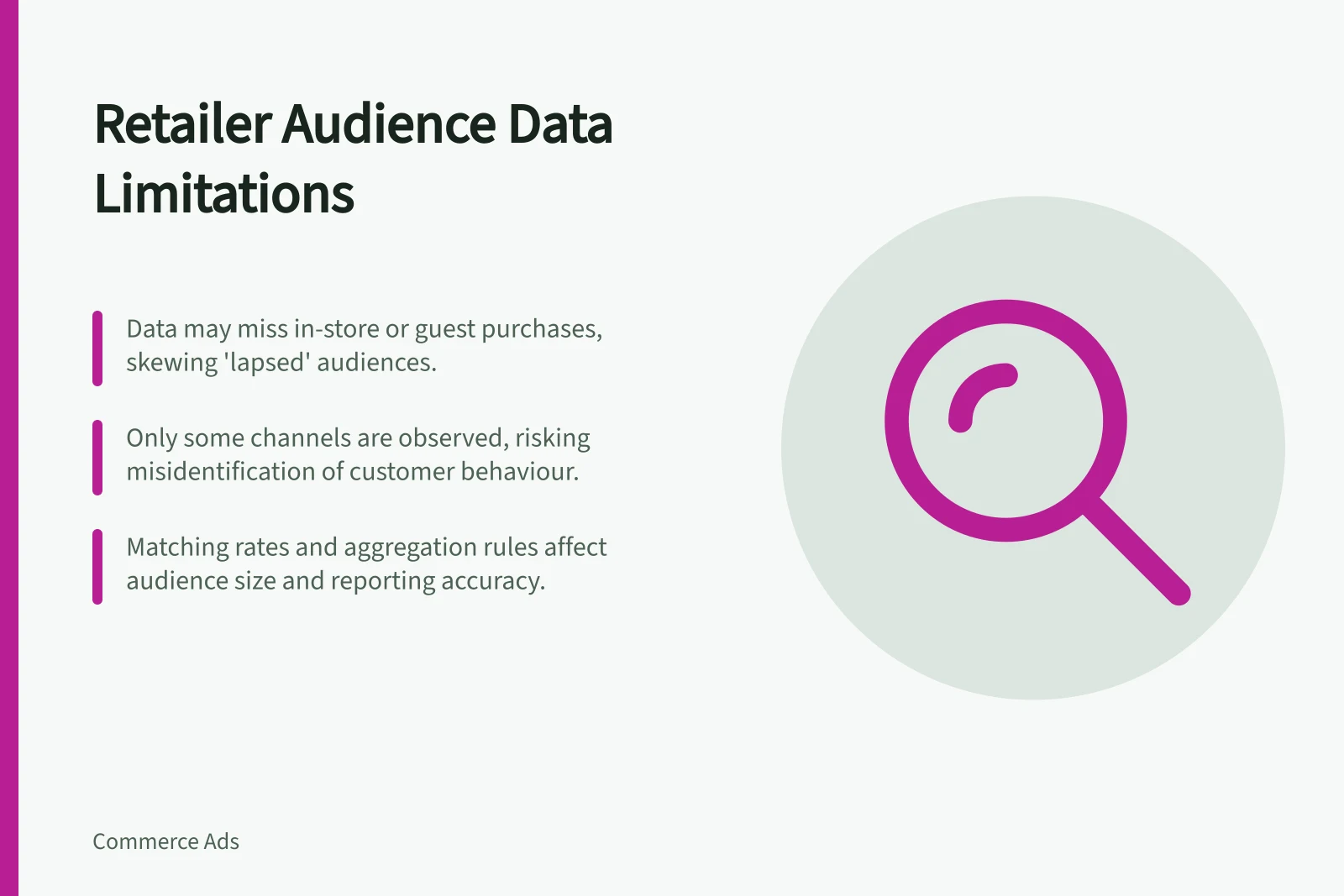
| Only some channels observed | A buyer may look “lapsed” after buying elsewhere | Channel coverage and known gaps |
| Delayed event processing | Recent buyers may still receive a message | Event-to-segment refresh time |
| Broad category mapping | Audience includes several different needs | Qualifying SKU or category list |
| Unknown match rate | Reach differs from source audience size | Eligible, matched and delivered counts |
| Restricted reporting | Small groups cannot be broken down safely | Aggregation and minimum reporting rules |
The table lists questions to investigate, not defects attributed to any particular retailer.
Key Questions to Investigate in Audience Data Limitations
- Are all channels (online, in-store, guest checkouts) included?Check for gaps in channel coverage.
- Are returns and delayed processing accounted for?Assess impact on recency and segment freshness.
- Is product categorisation precise?Verify if broad categories include unrelated items.
- What is the match rate between source and target audiences?Request eligible, matched, and delivered counts.
- Are aggregation rules in place for small groups?Confirm minimum reporting thresholds apply.
Critical Metrics to Request from Retailer Audience Data
- Channel Coverage
- Percentage of sales captured across online, in-store, guest checkout
- Event-to-Segment Refresh Time
- Time delay between transaction and audience update
- Match Rate
- Proportion of eligible users successfully matched
- Minimum Reporting Threshold
- Smallest group size that can be reported safely
Keep observed, inferred and modelled data distinct
Keep observed, inferred and modelled data distinct.
An observed transaction records a past purchase within the dataset. An inferred interest derives from behaviour. A modelled audience relies on additional assumptions. Each serves a different planning purpose, but the brief must specify which is used. Do not label an inferred segment as documented buyers.
Likewise, matching a retailer audience to off-site inventory does not grant the advertiser permission to inspect individual shoppers. Request aggregate counts and an explanation of matching and reporting limits. The ICO’s guidance on direct marketing emphasises fair, transparent profiling and respect for objections; involve the privacy team when data use or sharing is unclear.
Observed, Inferred, and Modelled Data: Key Differences
- Observed Data
- Recorded past purchases within the dataset; directly measurable events.
- Inferred Data
- Derived from behaviour (e.g., browsing, cart abandonment); not a direct purchase.
- Modelled Data
- Generated using assumptions and algorithms; predicts audience characteristics.
Record uncertainty before the result arrives
Record uncertainty before the result arrives.
Use a four-column register: known fact; unknown or limitation; likely direction of bias; action. For example, if in-store purchases are not fully linked to customer records, “lapsed” audiences may contain some recent buyers. The action might be to narrow the claim, adjust the creative or request a sensitivity analysis. If the direction of bias is unknown, say so.
Keep the register with the audience definition and campaign version. If coverage changes during the campaign, note the date and revise interpretation. A report produced after the fact may otherwise appear to compare like with like when the underlying data changed.
Creating a Limitations Register for Retailer Audience Data
- Document known factsList what data is confirmed and sourced.
- Identify limitations or unknownsNote missing coverage, matching issues, or timing delays.
- Assess likely direction of biasDetermine whether results may over- or understate outcomes.
- Define action based on uncertaintyAdjust claims, creative, or test design accordingly.
Write conclusions that fit the evidence
Write conclusions that fit the evidence.
An attributed sales figure depends on the retailer’s matching and lookback rules. It can describe sales connected to exposed shoppers under that method; it does not by itself establish extra sales caused by the adverts. A claim of uplift needs a suitable comparison design and its uncertainty. IAB Europe’s commerce media measurement standards provide shared terminology, but the retailer’s actual implementation still has to be disclosed.
If a limitation prevents a strong conclusion, the next action may be a smaller test, a different audience definition or better data documentation. That is a useful result. The aim of the limitations register is to make the next decision more accurate, not to make every chart look certain.