Retail Media Planning
Part of Retail audience planning
Choosing exclusions for off-site retail audience campaigns
Separate recent-buyer screening, campaign overlap and rights-based suppression in off-site retail campaigns.
An exclusion is useful when it prevents an irrelevant message, honours a person’s preference or keeps a test interpretable. Each reason needs a separate rule. Do not bundle legal suppression, recent purchasers and campaign overlap into one vague “excluded audience” number.
Name the purpose of every exclusion
| Exclusion | Possible reason | Check before activation |
|---|---|---|
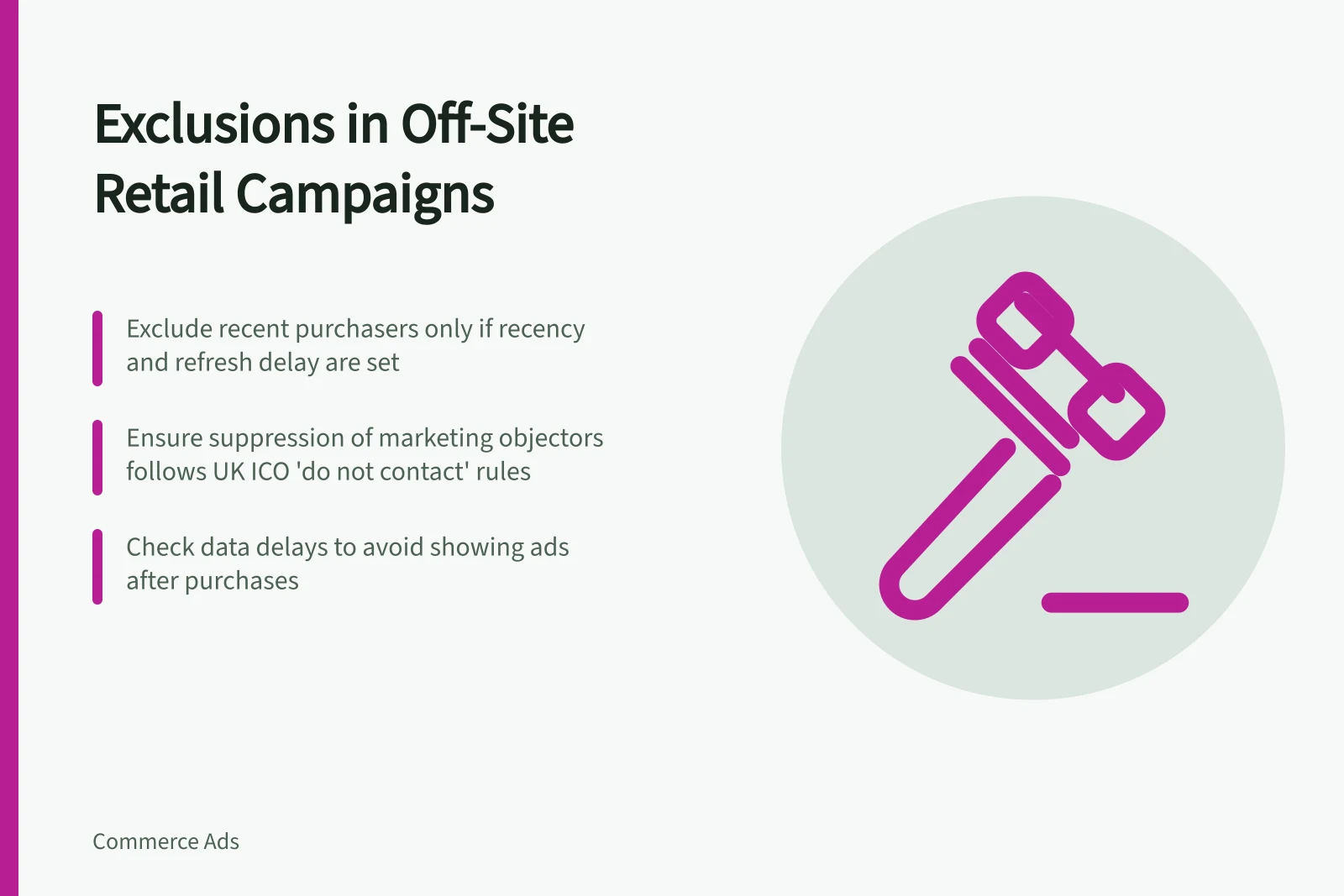
| Recent purchasers of the promoted item | Avoid an immediate repeat-purchase message | Product set, recency and refresh delay |
| People in another campaign | Reduce duplicate exposure or protect a comparison | Which campaign has priority? |
| Locations without the item | Avoid sending people to unavailable stock | How often availability changes |
| People who objected to marketing | Respect their preference | Suppression process and update timing |
These rules may have different owners and data sources. The UK ICO advises that when someone no longer wants their information used for direct marketing, their details should go on a suppression or ‘do not contact’ list rather than be deleted. Treat this as a rights-handling obligation with the privacy team’s process, not as optional media optimisation.
Avoid excluding the people the campaign is meant to help
A recent category buyer might be a good prospect for a complementary product, whereas a recent buyer of the same long-lasting item might not. Excluding all recent category activity could eliminate the audience the brief was meant to reach. Begin with the exact promoted product and commercial purpose; widen the exclusion only when there is a reason.
Ask the retailer how much reachable audience remains after each rule, and whether the rules are evaluated in a known order. An audience can shrink sharply when several broad exclusions overlap. Record the reach before and after without seeking identities of the removed individuals.
Check data timing and scope
If purchase data updates later than campaign delivery, a person may continue seeing an advert after buying. Establish the expected delay and decide whether the message remains acceptable during that interval. If the retailer observes only some shops or channels, recent-purchaser suppression removes only buyers visible in the available data. No observed qualifying purchase does not prove that a person bought nothing elsewhere.
Confirm whether exclusions apply across all off-site inventory in the plan, and whether another platform has its own frequency or suppression rules. Do not assume one upload or one segment name controls every channel. Ask for a process to update or remove a rule during the campaign and log when it changed.
Key Considerations in Exclusion Management
- Data lag risk
- Purchase data may update after campaign delivery
- Partial visibility
- Suppression only applies to buyers visible in available data
- Audience shrinkage
- Multiple overlapping exclusions can reduce reach sharply
- Legal obligation
- Objections to marketing must be respected regardless of test group
Keep test design separate from customer rights
A comparison group may deliberately withhold an advert so results can be compared. That is an analytical exclusion, not a substitute for privacy suppression. A person who objects to direct marketing must be handled according to the applicable rules, regardless of which test group they occupy. The responsible legal and privacy teams should confirm the exact activation design.
After launch, report the audience size and delivery that remain after exclusions, plus the major limitations. If the campaign underdelivers, check the sequence and scope of exclusions before concluding that the intended audience does not exist. A clear exclusion record makes that diagnosis possible.