Commerce Budgets
Part of Retail media investment reviews
Assessing product readiness before adding more budget
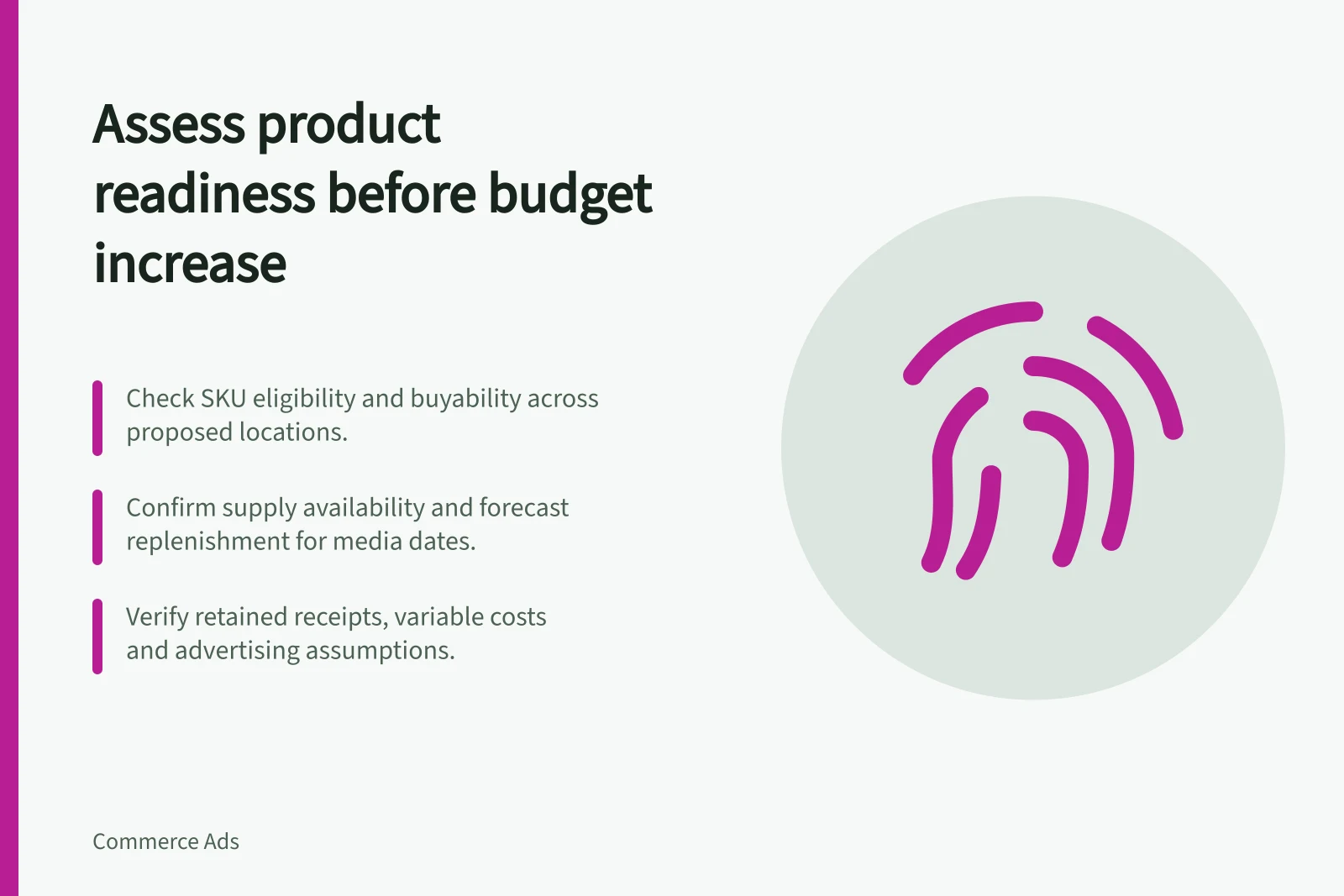
Check item eligibility, buying routes, supply and economics before adding retail media budget.
Increase retail media budget for a product only after checking that the exact item is eligible, buyable across the proposed media footprint and commercially suitable for the next flight. Review current conditions and the supply outlook; last campaign’s attributed sales cannot settle either question.
Check the item and buying route
List the SKU or variant, proposed placement, destination, dates and locations. Inspect the live page for the correct pack, size or model, current price, offer terms and essential buying details.
Check the relevant delivery, collection or store route. Record where and when the check was made: one postcode or store does not establish wider availability.
Ask the retailer to confirm eligibility for the proposed unit. Amazon’s UK Sponsored Products guidance recommends including products that are in stock and choosing products displaying the featured offer. Confirm the chosen retailer’s rules and the actual item rather than applying Amazon’s behaviour elsewhere.
Check whether readiness can last
A product can be buyable today yet unable to support a larger booking next week. Ask the supply and commercial owners for saleable stock by relevant location, expected replenishment, competing demand and planned range changes. Match that view to the proposed media dates and coverage. Label forecast supply as a forecast.
Agree who monitors availability, how fresh the signal is and who can narrow, pause or replace the advert under the booking’s terms. A substitute needs its own eligibility, page, message and economics check.
Assessing Product Readiness for Retail Media Budget Increase
- Confirm current stock availability by locationCheck with supply and commercial teams
- Review expected replenishment and competing demandAssess against media flight dates
- Identify planned range changes affecting availabilityAlign with proposed coverage
- Agree on monitoring and response protocolDefine who monitors, refresh frequency, and replacement process
Check economics and the purpose of more spend
Use the advertiser’s retained receipts and relevant variable costs for the exact item. Price support, trading terms, fulfilment and expected returns can alter what remains to pay for media. Shopper sales value reported by a retailer is not automatically the advertiser’s receipts. If an increase depends on additional sales caused by advertising, state that assumption: attributed sales alone do not measure them.
Say what the extra budget should achieve or teach. If stock, price, destination and targeting all change at once, the next result may be harder to interpret. Set the outcome and review condition before committing.
| Decision | Readiness condition |
|---|---|
| Add budget | The item is confirmed eligible and buyable for the planned footprint; supply, page and economics support the flight. |
| Narrow or delay | A defined variant, area or period has a fixable gap. |
| Hold | Eligibility, buyability or material cost information is missing or unreliable. |
These are decision prompts, not universal stock or margin thresholds. Date the checks and name their owners. Reassess a held product after the underlying condition changes.
Decision Triggers Based on Readiness Assessment
- Add budgetItem is eligible and buyable across planned footprint; supply, page and economics support the flight.
- Narrow or delayA defined variant, area or period has a fixable gap.
- HoldEligibility, buyability or material cost information is missing or unreliable.
Key Metrics to Verify Before Increasing Spend
- Retained receipts (advertiser)
- Use actual retained receipts and variable costs
- Price support and trading terms
- Impact media cost allocation
- Fulfilment and return expectations
- Adjust net margin calculations
- Shopper sales value ≠ Advertiser receipts
- Not automatically equivalent; verify source