Retail Media Planning
Retail media investment reviews
Review retail media delivery, credited sales and commercial value before deciding what to fund next.
A retail media investment review should establish what was bought, what happened, what the evidence can support and what the advertiser should fund next. Keep delivery, retailer-credited sales and commercial contribution separate. None, on its own, establishes sales caused by advertising.
Reconstruct the approved investment
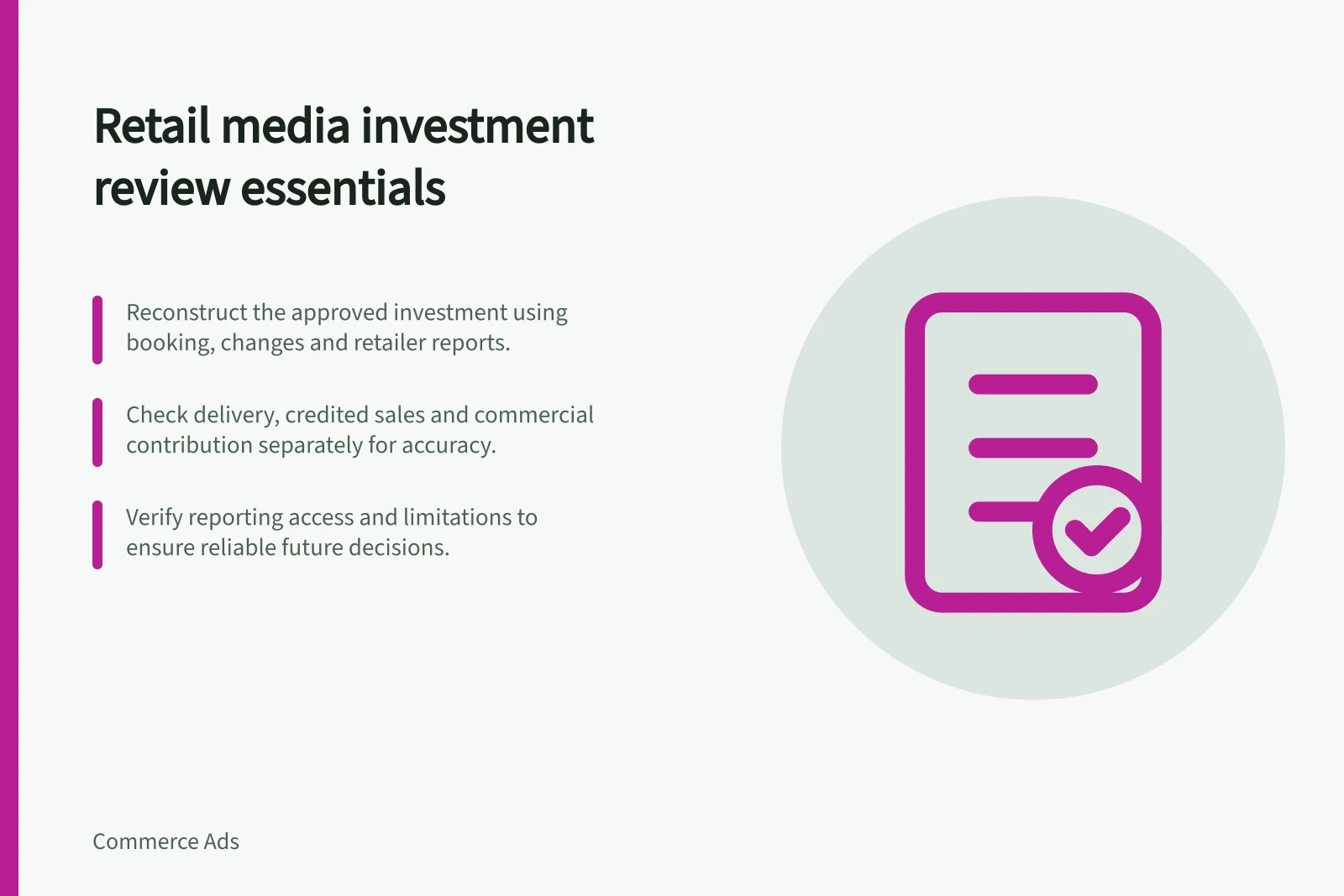
Put the approved brief, final booking, dated changes, charges and retailer reports together. Record the products, placements, dates, audience or store coverage, intended buying route and commercial objective. If the campaign changed during the flight, identify the affected period or line rather than treating it as one unchanged plan.
Mark material delivery and billing items as verified, changed with approval, disputed or not verifiable. Resolve questions that could change the next commitment. A proposal forecast is not evidence of delivered activity.
Read the evidence in layers
| Question | Evidence | Limit |
|---|---|---|
| Did the booked media run? | Booking, charges and reported impressions, clicks or in-store plays, as applicable | Delivery does not establish attention or sales. |
| Which purchases did the retailer credit? | Attributed sales with the product set, channels, interaction rule, lookback and gross or net basis | Credited purchases are not necessarily additional purchases. |
| What did the advertiser retain? | Its receipts, relevant costs, returns, trading terms and campaign charges | Shopper sales value is not the advertiser’s profit. |
| Did advertising cause an additional outcome? | A credible comparison and its uncertainty, if one was conducted | Without one, incrementality remains unknown. |
IAB Europe publishes Commerce Media Measurement Standards. Keep each retailer’s actual labels and methodology with its figures. A UK study found differences between five retail media networks in definitions of core metrics, including attributed sales.
Use the advertiser’s own commercial records for the contribution view. A supplier may receive less than the shopper paid; a marketplace seller may owe fulfilment and transaction charges. Count an allowance once if it has already reduced receipts. Mark unsettled returns or invoices as provisional.
Return on ad spend can be shown alongside this view, but cannot replace it.
Retail Media Network Metric Definitions: UK Study Findings
- Attributed Sales Definition
- Varied across networks; some used gross, others net basis
- Interaction Rule
- Differed between last-click and multi-touch models
Check what reporting access the next review can rely on
Reporting access is not uniform across UK retail media networks. Self-service access, reporting transparency and measurement sophistication can vary by retailer, buying model and advertiser tier. Record which capabilities were available for the completed investment.
When a result depends on a report or platform view, note whether the advertiser could access it directly and whether the detail needed for the review was available. If access or transparency was limited, carry that constraint into the next commitment rather than treating the evidence as equally complete across investments.
No single retailer currently combines all leading practices. A decision can therefore recognise a useful result while still recording a reporting limitation that affects how confidently it can guide future spend.
Reporting Access Limitations Across UK Retail Media Networks
- Pros
- Self-service access and transparent reporting available on some platforms
- Cons
- Access and detail vary by retailer, buying model and advertiser tier
Distinguish an unfavourable result from an unusable one
A well-defined campaign that missed its objective can still answer the investment question. A campaign with uncertain delivery, an unavailable product or an undefined sales figure may support only a narrower conclusion.
Record changes in availability, price, promotion, creative and targeting before interpreting the result. An uncontrolled before-and-after comparison cannot assign a sales change to advertising alone.
Record the next commitment
For each proposed investment, state repeat, narrow, investigate or stop, with the evidence and condition behind the choice. Repeat only after checking that the product, economics and proposed booking still suit the objective. Narrow when the supportable case concerns particular products, locations or periods.
Investigate a material gap that could change the decision, naming the answer needed and its owner. Stop when the line no longer serves the objective on acceptable terms or another use of the budget takes priority.
Keep the decision, approver, evidence version, accepted limits and date together.
In this guide
- Assessing product readiness before adding more budgetCheck item eligibility, buying routes, supply and economics before adding retail media budget.
- Comparing retailer campaign outcomes with commercial objectivesMatch retail media delivery, credited sales and advertiser contribution to the objective originally approved.
- Identifying spend that produced no useful learningAudit campaign questions, delivery and outcomes to find spend that could not inform a decision.
- Deciding whether to repeat, narrow or stop a retail media campaignUse campaign evidence and current conditions to decide whether to repeat, narrow or stop a retail media booking.