Commerce Budgets
Part of Commerce advertising budgets
Calculating a margin-based retail media spending limit
Calculate a retail media spend ceiling from product contribution, fixed charges and a clearly labelled incremental-sales scenario.
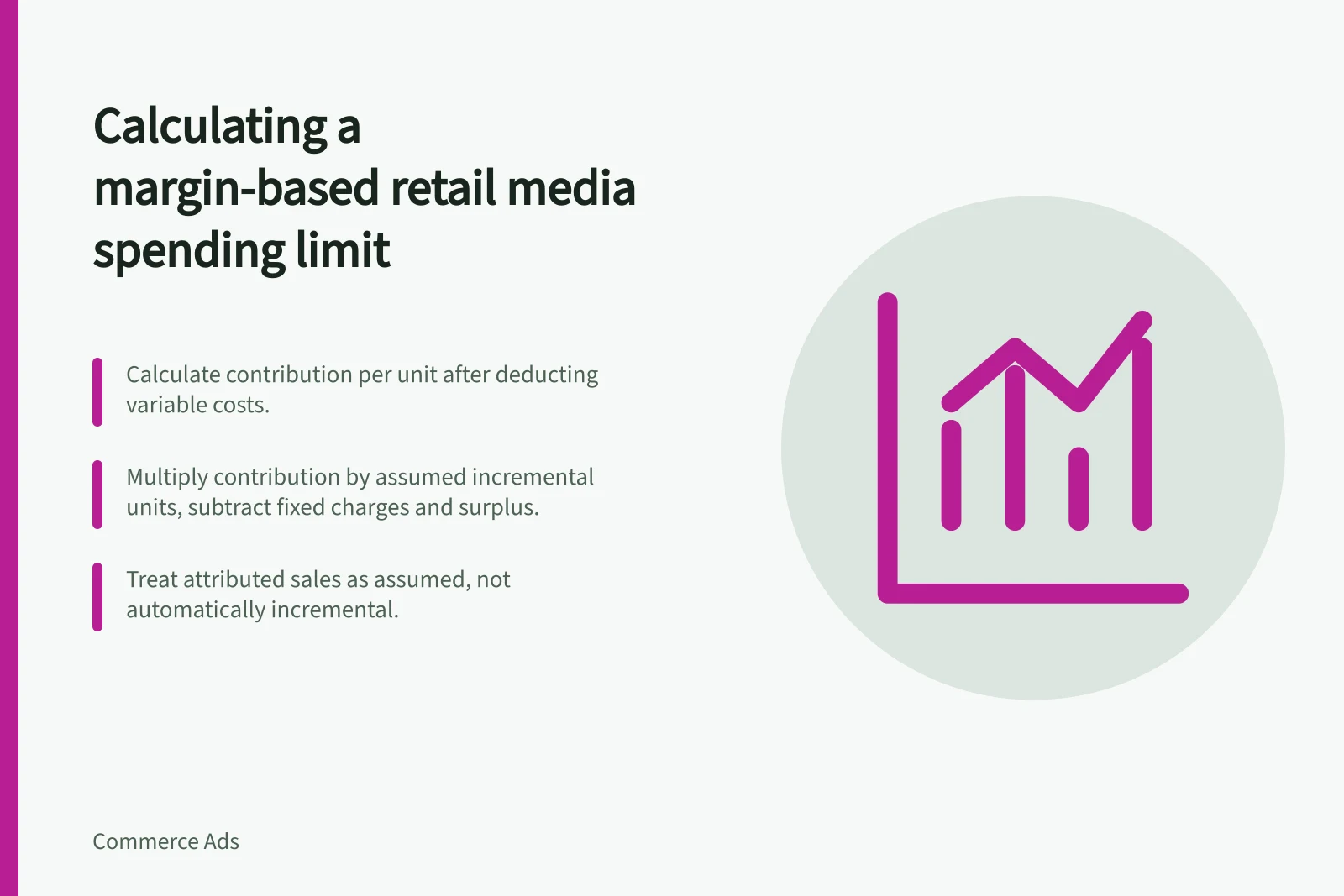
A margin-based spending limit caps campaign cost while preserving a contribution surplus if assumed additional sales occur. Calculate contribution per additional unit, apply an explicit incremental-sales scenario, then deduct fixed campaign charges and required surplus. Attributed sales are not automatically additional.
Calculate the advertiser’s contribution
Calculate the advertiser’s contribution
Start with what your business receives from an additional sale, excluding amounts it does not retain. A supplier may receive a wholesale amount rather than the retailer’s shelf price. A marketplace seller may receive the consumer payment but owe marketplace and fulfilment charges. Use the route that applies to the product.
Subtract costs that change with the sale: product cost, variable retailer charges, fulfilment, expected returns and per-unit promotional funding. Be consistent about tax, discounts and refunds. If an allowance already reduces net receipts, do not subtract it again. Keep fixed creative, data or management charges separate.
Calculate materially different variants separately. A blended contribution is useful only with a documented sales mix.
Margin-based retail media spending limit: step-by-step
- Calculate the advertiser’s contributionDetermine net contribution per additional unit: start with net receipts (wholesale or net of marketplace/fulfilment charges), subtract variable costs (product cost, variable retailer charges, fulfilment, expected returns, per-unit promotional funding). Keep fixed charges separate. Calculate materially different variants separately; use a documented sales mix for blended values.
- Turn contribution into a ceilingChoose an assumed number of incremental units and label it as a scenario. Multiply by contribution per unit, then subtract fixed campaign charges and the required contribution surplus. Apply any lower cash or risk limit. If the result is zero or negative, that scenario does not support positive media spend.
- Test the assumptionRepeat the calculation for plausible sales quantities and changes in contribution: lower-margin product mix, reduced receipts during promotions, higher returns, and potential cannibalisation across the advertiser’s range. Use a suitable comparison method if incrementality is measured; otherwise keep the figure labelled as an assumption. Save the dated calculation and recalculate when price, terms, stock or campaign scope changes.
Turn contribution into a ceiling
Turn contribution into a ceiling
Choose an assumed number of incremental units and label it as a scenario. Multiply it by contribution per unit, then subtract fixed campaign charges and the contribution surplus the business requires. Apply any lower cash or risk limit.
If the result is zero or negative, that scenario does not support positive media spend. A launch or learning investment can still be approved explicitly, without describing it as a break-even sales campaign.
Test the assumption
Test the assumption
Repeat the calculation for a few plausible sales quantities and changes in contribution. Check a lower-margin product mix, reduced receipts during a promotion and higher returns. If the campaign may shift purchases from another product in the advertiser’s range, assess the net contribution effect rather than counting every promoted-item sale as new business.
A retailer may attribute sales after a click or advert view, count a wider product set, or use gross rather than net sales. Its lookback window also matters.
None of these choices shows how many sales would have happened without the advert. Use a suitable comparison method if the spending decision depends on measured incrementality; otherwise keep the incremental-sales figure labelled as an assumption.
Save the dated calculation with its receipts basis, costs, product mix, sales scenario, required surplus and approved ceiling. Recalculate when price, terms, stock or campaign scope changes.