Retail Media Planning
Part of Commerce advertising budgets
Planning spend across retailers with different pricing models
Compare CPC, impression-based and fixed-term retail media offers by commitment, flexibility, eligibility and reporting.
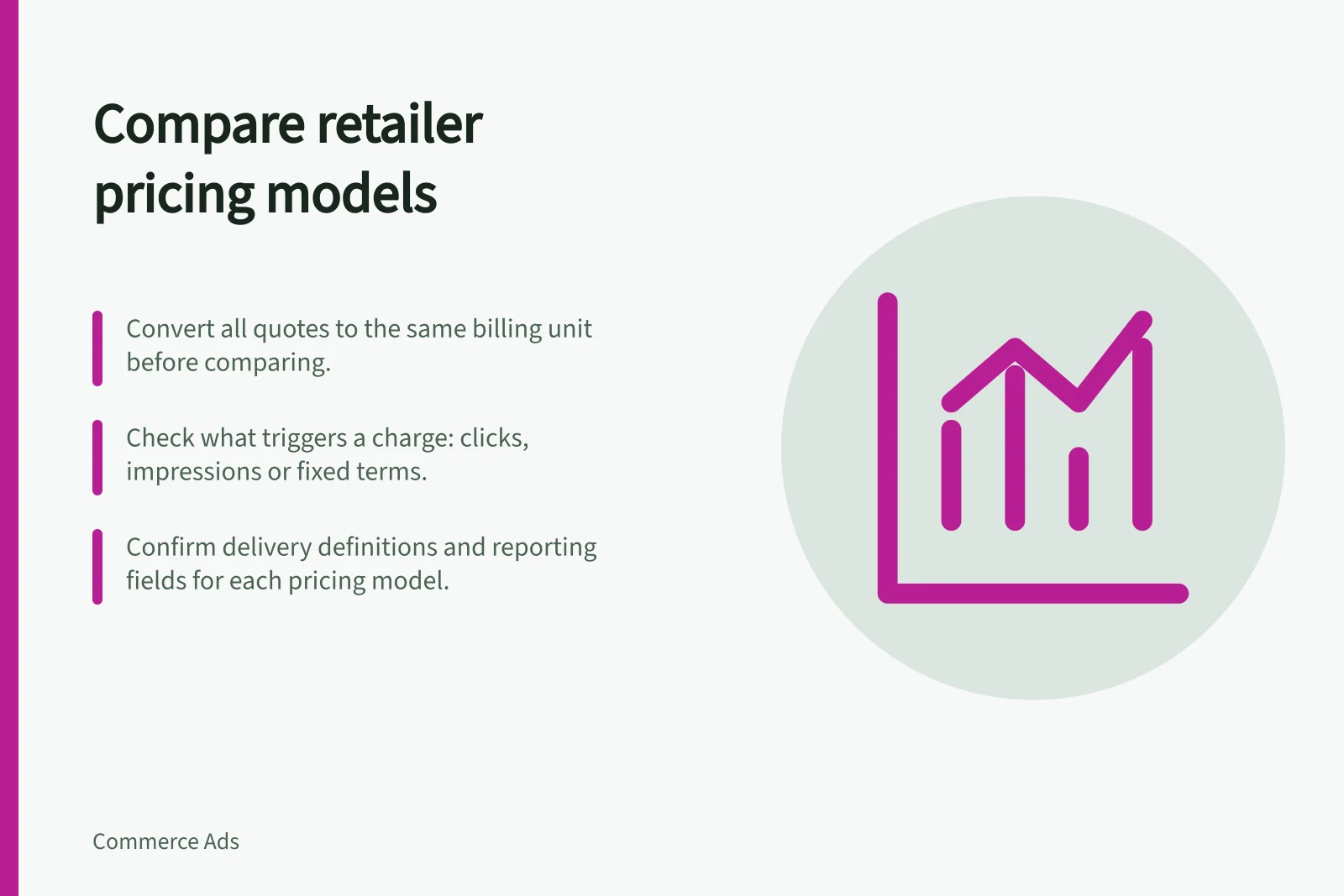
Compare retailer media offers by the total amount at risk, what triggers a charge, what can be changed and the result each booking is meant to support. A click price, impression price and fixed-term fee are different units; none alone identifies the better use of a budget.
Put offers on the same planning sheet
Put offers on the same planning sheet
Ask each retailer for the eligible products, placement and device or store coverage, dates, billing event, bid or contracted amount, any minimum, production and service charges, change rights and reporting fields. Use the same campaign purpose and product group where possible. Record material differences before comparing quotes.
| Buying basis | What creates a charge | Planning check |
|---|---|---|
| Cost per click (CPC) | A billable click under the platform’s rules | Check the spending controls and whether the product economics can support the cost of visits that do not become sales. |
| Cost per impression (CPI) | One billable impression under the seller’s definition | Confirm the impression definition and delivery report. |
| Cost per thousand impressions (CPM) | A thousand billable impressions | Confirm whether the quoted rate covers served or another defined impression type. |
| Viewable CPM (vCPM) | A thousand viewable impressions under the stated method | Check the viewability definition; viewability is not a sales outcome. |
| Fixed period or package | The contracted space or service for agreed dates | Check included services, cancellation rights and any delivery remedy. |
Do not assume every retailer uses the abbreviations alike. Nectar360 explicitly uses CPI to mean cost per impression, not cost per thousand impressions. Convert an impression quote into an estimated total charge using its own billing unit before comparing it with a CPM quote.
Apply the published terms narrowly
Apply the published terms narrowly
Amazon Sponsored Products illustrates adjustable CPC buying for individual product listings. Advertisers choose bids and daily budgets, and clicks lead to the advertised product detail page.
Advertisers select products to advertise and choose keywords to target or let Amazon’s systems target relevant keywords automatically. Confirm the proposed products and account before assigning spend.
Sainsbury’s placements through Nectar360 show several buying bases at one retailer. Its published Search In Grid sponsored product is CPC and allows preferred bids by search term. These are descriptions of possible units, not confirmation of a particular SKU, device, date, account access or available inventory.
Amazon display ads are described in Amazon’s self-service guide as a campaign where advertisers choose a duration, budget and bid optimisation strategy. The guide describes display ads for vendors and professional sellers enrolled in Amazon Brand Registry. Confirm the proposed advertiser, destination and buying controls; do not apply these terms to managed display or another retailer’s screens.
These examples establish buying differences, not a performance ranking or a tested campaign outcome.
Key Retailer Media Platform References and Definitions
- Amazon Sponsored ProductsCPC bidding with daily budgets and keyword targeting. Advertisers choose products and keywords or use automated targeting.
- Sainsbury’s Placements via Nectar360CPC-based Search In Grid with preferred bids by search term; multiple buying bases available at one retailer.
- Amazon Display AdsCampaigns with duration, budget, and bid optimisation strategy; for vendors and professional sellers enrolled in Amazon Brand Registry.
- IAB Europe Commerce Media Measurement Standards v2Provides framework for consistent measurement across retail media platforms including definitions of viewability and attribution.
Allocate against commitments
Allocate against commitments
Enter an authorised maximum for each adjustable campaign and the contracted amount for each fixed placement. Add known creative, data and management fees separately, then check the sum against the approved budget and product economics. Reserve a committed amount until a change or cancellation is confirmed.
For CPC, estimate clicks from a stated spend and assumed average charge. For CPI, CPM or vCPM, estimate billable delivery from the quote using the correct unit. These are exposure or traffic scenarios, not sales forecasts. Ask what evidence will verify delivery, and decide what would justify keeping, reducing or reallocating spend.
Finally, compare outcome reports only on definitions the providers can supply. Product sets, gross or net sales and attribution windows may differ. Label gaps rather than using attributed sales to declare one pricing model more profitable without the advertiser’s costs and a suitable basis for assessing additional sales.