Commerce Budgets
Commerce advertising budgets
Build a commerce advertising budget around product economics, existing commitments, media buying terms and clear review decisions.
A commerce advertising budget should show what the business can commit, what each payment buys and when that commitment can change. Start with product economics and existing obligations, then approve media lines against a clear purpose. A retailer’s suggested spend is an input to the decision, not the budget itself.
Know the UK market context
In 2024, 3.5 million UK businesses relied on advertising services, collectively spending an estimated £66.6bn. Of this, £42.6bn was media spend, £7.4bn went to agencies and production, and £16.6bn to in-house marketing professionals.
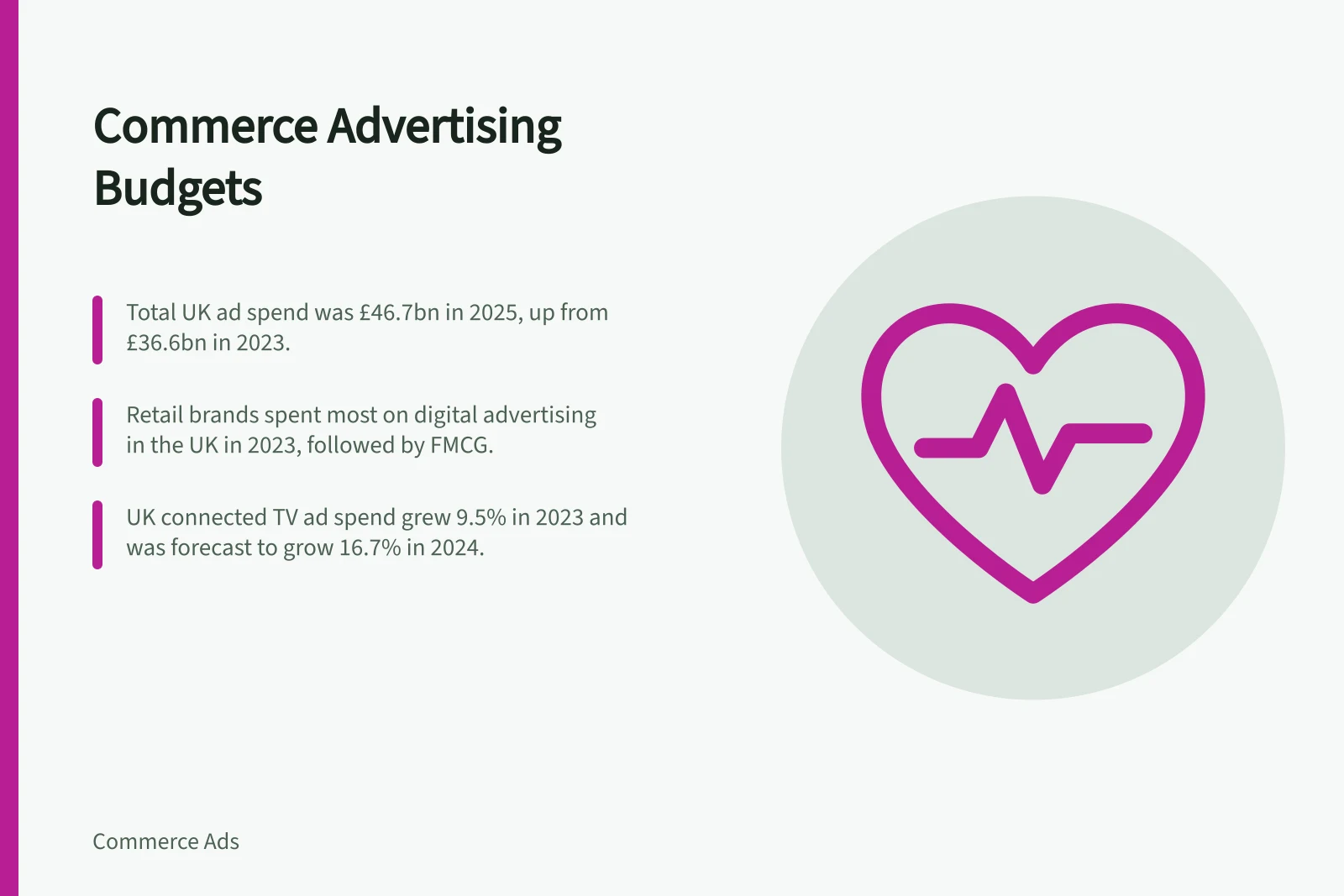
Total UK advertising spend was reported as £46.7bn in 2025 and £36.6bn in 2023; figures from 2025 onwards are not fully comparable with earlier years because the Advertising Association and WARC changed their reporting methodology in April 2026. Digital advertising dominates the market.
The UK ad market was forecast to grow 4% to £37.1bn in 2024, with global ad spend rising 8.2% to $1trn (£788bn). Retail brands spent the most on digital advertising in the UK in 2023, followed by FMCG. UK spend on connected TV grew 9.5% in 2023 and was expected to grow 16.7% in 2024.
Businesses face increasing regulatory scrutiny, raising compliance risks. First-party data is becoming increasingly important as stricter privacy regulations in the EU and UK evolve.
Artificial intelligence is rapidly transforming the industry, reshaping creative production, media buying and how brands reach consumers.
In 2024, there were 21,262 advertising enterprises in the UK, with total turnover of £42.6bn and approximate gross value added of £19.4bn.
Exports of UK advertising services were worth £19.4bn in 2025, second only to the US. The government identified the industry as a key frontier industry with particularly high growth potential in its June 2025 Creative Industries Sector Plan.
Build one view of costs
Put costs for the same campaign period in one schedule.
| Cost | Record |
|---|---|
| Media | Placement, buying unit, dates, authorised cap or contracted amount, and change rights. |
| Production and services | Creative, management, data and measurement charges, including what each fee covers. |
| Trade commitments | Promotional funding and agreed retailer terms that affect the product’s economics. |
| Contingency | Money held for a stated risk or later decision. |
A package may combine these items. Ask for its components and keep an unresolved amount marked as mixed.
Record the quote’s currency, tax basis and invoice route. Trade funding may reduce receipts or appear as a separate payment; show its effect once in the commercial calculation and keep the obligation visible in the commitment schedule.
Key Elements to Include in a Commerce Advertising Commitment Schedule
- Mediaplacement, buying unit, dates, cap or contract amount, change rights
- Production and servicescreative, management, data, measurement fees
- Trade commitmentspromotional funding, retailer terms affecting economics
- Contingencyreserved for risk or future decisions
- Currency, tax basis, and invoice route recorded
Account for cost pressures
In a survey of 328 senior leaders across UK retail brands, 54% cited rising business costs and 53% cited fulfilment and delivery costs as the biggest barriers to growth. Only 10% named customer acquisition costs as the main constraint.
Set the ceiling before allocating spend
Use the amount the advertiser receives from an additional sale, less the costs that change with that sale. A supplier selling through a retailer should use its own receipts, not the retailer’s shelf price.
Include applicable discounts, retailer terms, fulfilment and expected returns without counting any cost twice. Calculate materially different products separately.
Decide what contribution must remain after the campaign, or explicitly approve a learning or launch investment. A margin-based ceiling depends on an assumed number of additional sales; it is not a sales forecast. Record any lower cash or risk limit as well.
Steps to Set a Commerce Advertising Budget
- Assess product economics and existing obligations
- Determine contribution margin per sale (net of costs)
- Set ceiling based on expected incremental sales and margin
- Allocate spend against clear campaign purposes
- Record commitments with change rights and review dates
Give each booking a purpose
For each line, record its objective, eligible products, dates, buying unit, maximum commitment, owner, change deadline and promised report. Confirm that the products can be bought through the route the advert promotes.
Keep provisional inventory marked provisional, and do not promise reserved money to another booking.
Buying terms affect flexibility. A cost-per-click campaign may allow changes to bids and budgets, subject to the platform’s rules, but clicks can accrue without sales.
An impression-based booking charges against its stated impression definition; delivery alone does not establish attention. A fixed-term placement may remain payable after priorities change. Compare total commitments and change rights as well as unit prices.
Sainsbury's Groceries online offers a selection of Sponsored Products, Banners and Enhanced Media. Nectar360 states that its Sponsored Products placements run on a cost-per-click model, with minimum starting bids of £0.45. Nectar360's placement page says around 21% of add-to-baskets come from search and that the Sainsbury’s app accounts for about 20% of online visits.
Top UK Commerce Media Platforms (Based on Placement Availability)
- Amazon Sponsored ProductsAvailable via Professional Selling Plan; up to $1000 USD ad credits for new sellers
- Sainsbury's Groceries Online (Nectar360)Sponsored Products, Banners, Enhanced Media; minimum bid £0.45 CPC
Pace and revise the plan
Set review dates before launch. Track approved commitments, amounts charged and remaining authority separately.
For adjustable campaigns, review spend alongside product availability and the measure relevant to their purpose. For contracted placements, compare delivery evidence with the booking and record any agreed remedy for a shortfall.
When moving money, record what has actually been released, what remains committed and why the new use is preferable. Do not treat a cancellation as available budget until it is confirmed. Retain the original approved plan alongside later changes.
Amazon offers up to $1000 USD in Sponsored Products ad credits for new sellers on the Professional selling plan who launch and spend within 30 days of their first campaign; availability depends on location.
Read the result on its stated basis
Before using return on ad spend to defend a budget, establish whether reported sales are gross or net, which products count, and whether attribution follows a click or an advert view.
Attributed sales are purchases associated with advertising under stated rules; they are not proof of additional sales caused by it. A causal claim requires an appropriate comparison method.
Use the result to inform the next cycle’s ceiling and review dates.
In this guide
- Calculating a margin-based retail media spending limitCalculate a retail media spend ceiling from product contribution, fixed charges and a clearly labelled incremental-sales scenario.
- Separating media costs from trade marketing commitmentsClassify retailer charges by what they buy, split mixed packages and keep trade commitments visible beside media costs.
- Planning spend across retailers with different pricing modelsCompare CPC, impression-based and fixed-term retail media offers by commitment, flexibility, eligibility and reporting.