Retail Media Planning
Retail media during promotions
Coordinate UK retail media with a live offer, available stock, clear measurement and a commercial close-out.
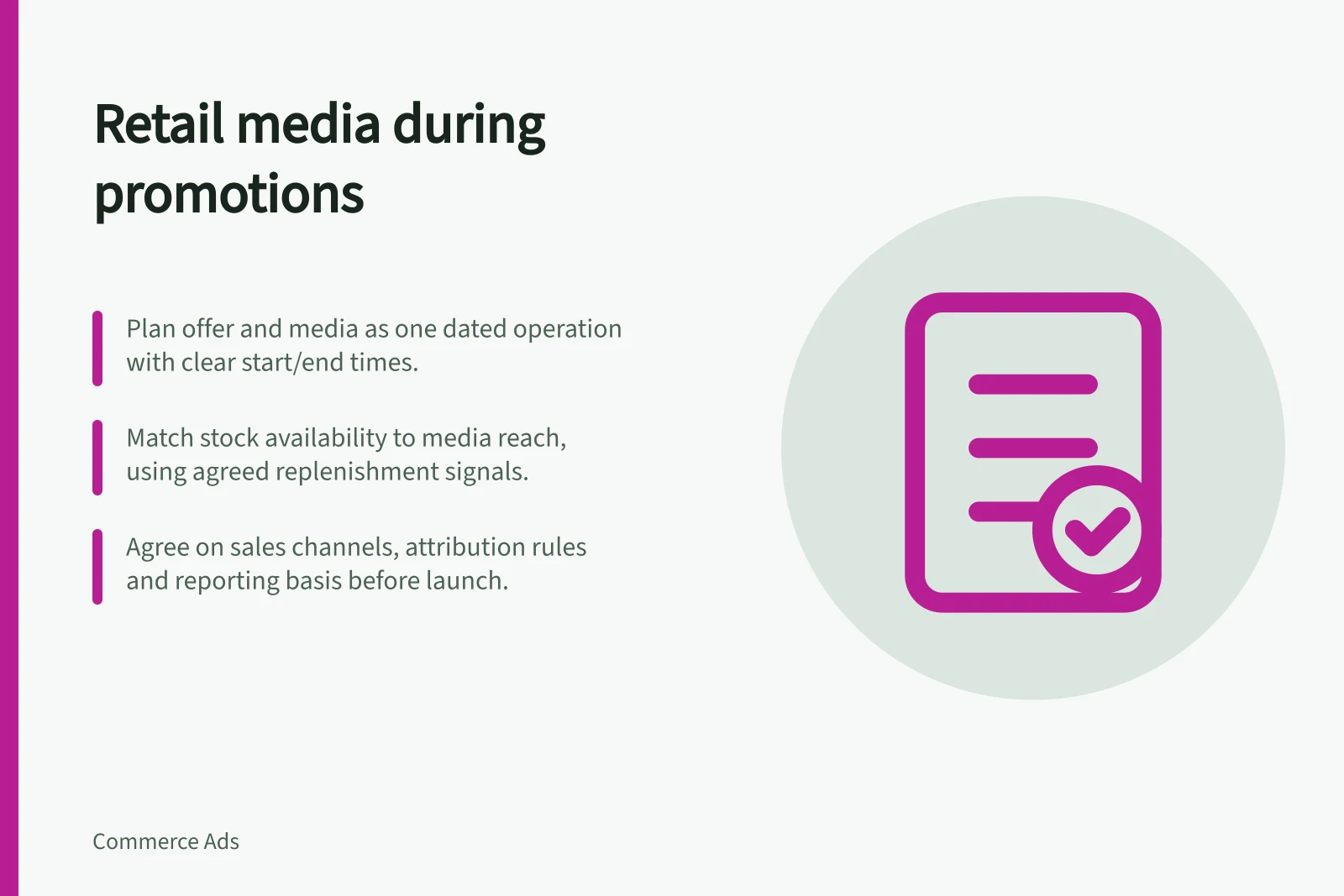
Plan the offer and media as one dated operation. Before booking a UK promotion, confirm what shoppers will be offered, where advertised products can be bought, who can change the media and what the final report will measure. Recheck these conditions when the offer goes live and whenever it changes.
Keep one promotion record
For each advertised SKU, record the offer, eligible channels and locations, start and end times, participating variants, purchase conditions and destination. Add the booked placement, creative version and an owner for updates. A campaign with national media may need narrower coverage if the offer or buying route varies by location.
Separate a proposed offer from a live one. Confirm the retailer’s price plan before approving creative, then check the shopper-facing price when the offer starts.
If an advert claims a saving, retain the price history and sales evidence supporting its comparison price. UK CAP guidance says reference prices must represent a genuine established usual selling price and must not mislead. It advises care with RRP comparisons.
For savings claims, CAP Code rule 3.39 says marketers must not mislead by falsely claiming a price advantage.
The CAP Code was amended following the Digital Markets, Competition and Consumers Act 2024, with the amendments coming into force on 7 April 2025. The ASA/CAP advice also points marketers to Chartered Trading Standards Institute pricing-practices guidance.
UK Regulatory Guidance on Promotional Claims
- CAP Code Rule 3.39
- Prohibits misleading claims about price advantages
- Amendment Date
- 7 April 2025
- Reference Price Requirement
- Must represent a genuine established usual selling price
- Guidance Source
- Chartered Trading Standards Institute pricing practices
Match availability to the media
Estimate likely demand with the planned publicity in mind, then compare saleable stock and confirmed replenishment with the stores and online areas the adverts reach.
CAP guidance on promotional availability calls for a reasonable estimate of response, appropriate information where demand cannot be met and timely communication in the event of an unexpectedly high response. A general ‘subject to availability’ statement does not replace that work.
Agree which stock signal will be used, how delayed it may be and who can narrow, change or stop a placement. Check the booking’s change rights, especially for fixed media. A replacement product needs its own offer, eligibility and creative check.
Decide what the report can show
Agree the product set, sales channels, attribution rules, lookback window and gross or net sales basis before launch. The retailer’s report may show media delivered and purchases credited under its rules. Neither an attributed-sales figure nor a comparison with an ordinary week separates the effect of advertising from the effect of the discount.
If that separation matters, arrange a suitable comparison before the sale. Otherwise, report the promotion’s observed outcome and the retailer’s attributed sales as distinct measures.
Agree who from trade and marketing will interpret the report, not just who receives it. Combining media results with the teams’ relevant sales data can help connect activity further from the point of sale with granular in-store outcomes, while keeping the retailer’s attribution measure distinct from the promotion’s observed result.
Align trade and marketing teams
Retail media can connect teams working towards the same sale but using different measures. IAB Europe describes trade teams as focused on moving stock, sell-through, revenue and margin, while marketing teams may focus on traffic, engagement and conversion. Agree the promotion and media plan together from the start so those aims are considered alongside one another.
Shared data can give both teams a more complete view. IAB Europe notes that trade teams can gain insight into channels further from the point of sale, while marketing teams can benefit from granular sales data, particularly in-store. Use the same sales evidence in the campaign review so teams can discuss impact in a common language.
Make the demand estimate comparable
A past promotion is a useful benchmark only when its mechanics and the promotional item’s value or desirability are sufficiently similar. CAP says a higher-value item or saving may produce a higher response, so a previous promotion may not support a direct comparison. Keep the basis for the estimate with the promotion record.
Consider when the offer runs as well as what it offers. CAP identifies events such as a major sporting occasion and seasonal periods including Christmas and Easter as factors that can affect response; it also cites higher expected demand for prosecco over a summer bank holiday weekend. If response is unexpectedly high, plan how consumers will be informed promptly.
Close the commercial record
Review media delivery, offer changes and stock exceptions against the same timeline. For detailed fee and returns reconciliation, follow the relevant trading terms and reconciliation process.
Use the result to decide whether to repeat the combination, change its timing or coverage, or stop a placement. State any limit on the conclusion, including outstanding returns or the absence of a credible estimate of advertising uplift.
In this guide
- Coordinating advertising with promotional pricesCheck UK sale claims, SKU eligibility and live retailer prices before and during a retail media campaign.
- Preventing stock shortages from wasting media spendMap promotional adverts to buyable stock, set shortage triggers and record media delivered during gaps.
- Separating discount effects from advertising effectsUse planned comparison groups to distinguish a promotion’s price effect from its retail media effect.
- Reviewing a sale period after retailer fees and returnsReconcile retained receipts, promotion funding, retailer charges, media spend and returns after a sale.