In-Store Media
Part of Commerce media procurement
Reviewing agency responsibilities in retailer-managed campaigns
Clarify paid agency work, approval authority and handoffs with a UK retailer-managed campaign from order to final charge.
A retailer-managed campaign requires an agreed advertiser–agency scope. Establish which agency work is already paid for, who may instruct the retailer, and who checks the booking, changes and final charges. The retailer operating the media does not handle those responsibilities.
Map the three-party handover
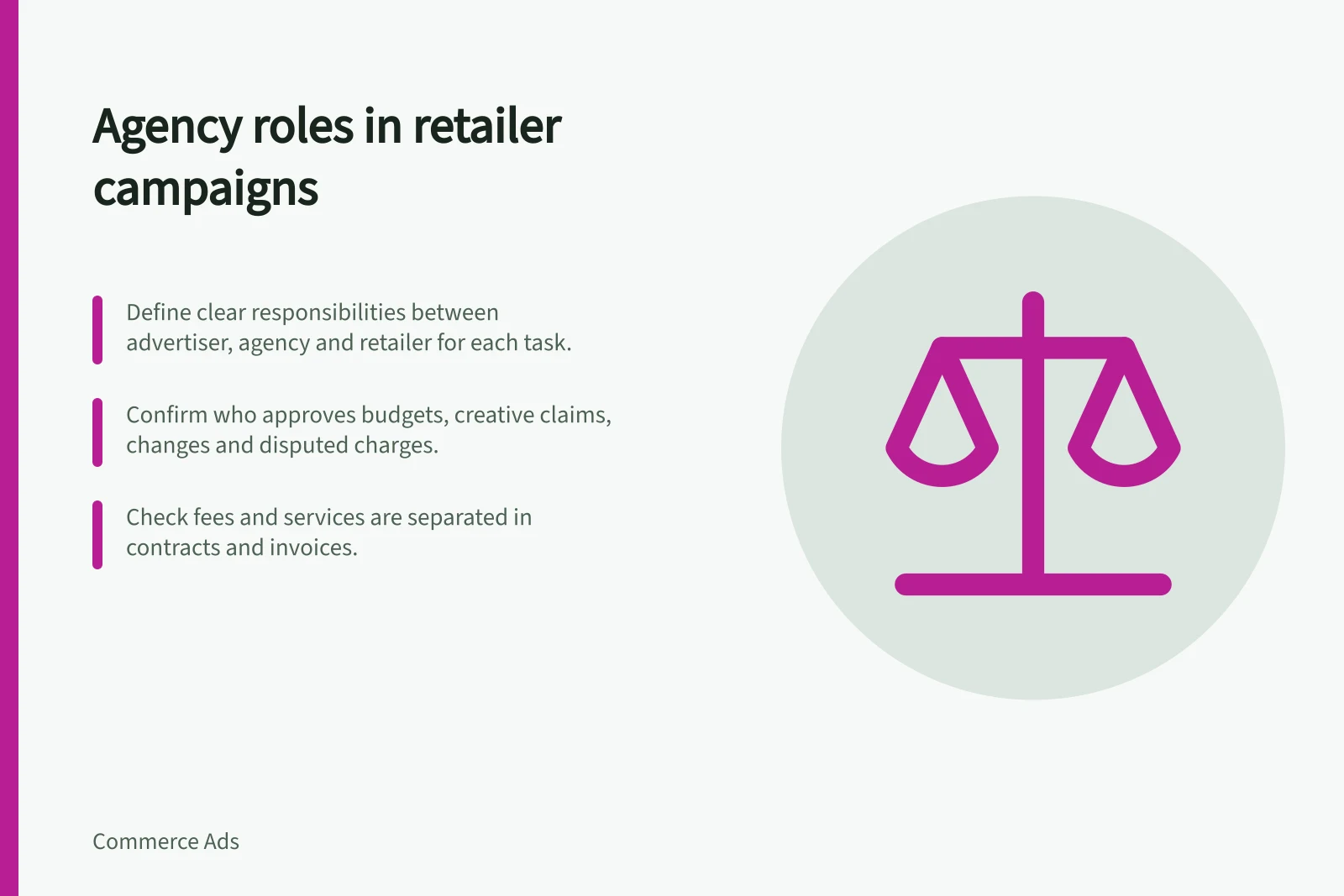
Map the advertiser, agency and retailer against each task. The advertiser should have a budget approver plus owners for product and claim accuracy. Ask the retailer what setup, trafficking, optimisation and reporting its managed service includes. Compare the remaining tasks with the agency’s statement of work.
| Task | Responsibility to settle |
|---|---|
| Brief and order | Who checks the retailer’s proposal and who may approve the commitment? |
| Creative and catalogue | Who supplies assets and SKU details, checks claims and obtains retailer approval? |
| Changes | Who detects a stock or price issue, requests action and confirms what changed? |
| Evidence | Who receives delivery records and challenges missing fields or disputed activity? |
| Finance | Who approves agency fees, retailer charges, credits and disputed items? |
Treat the table as a negotiation prompt, not a default allocation. Confirm the named owner, approval authority and paid scope for every material handover. An agency may advise and review while the retailer controls the buying interface, but the division must be established for the campaign.
Review fees and interests
Check whether retailer liaison, creative work, analysis and dispute handling sit in the agency appointment or are charged separately. Record who may approve a substituted placement or additional spend. On the order and invoices, distinguish the agency’s recommendations from the retailer’s managed-service work.
If the agency proposes a packaged or proprietary media offer, ask it to separate inventory, services, charges and delivery data from the retailer-managed booking. ISBA’s public guidance raises transparency and oversight questions for proprietary media, but does not assess a particular agency package.
ISBA’s 2025 Media Services Framework covers advertiser–media-agency strategy, planning and buying. Its detailed agreement is member-only, so the operative contract and statement of work determine actual duties. ISBA also says its creative-services framework does not cover media buying.
Key Guidance Sources for UK Retailer-Managed Campaigns
- 2025ISBA Media Services Framework — Covers strategy, planning and buying between advertisers and agencies.
- 2025ISBA Creative Services Framework Agreement (CSFA) — Does not cover media buying; focuses on creative services.
- 2026IAB Europe Commerce Media Measurement Standards V2 (Jan ) — Provides measurement standards for commerce media campaigns.
Give exceptions an owner
Before launch, decide who acts if a promoted product becomes unavailable, a placement is substituted, a report is late or a charge is disputed. For each event, identify who contacts the retailer, who approves the response and where confirmation is recorded. At close-out, compare the agency’s contracted deliverables with the work performed, and keep unresolved retailer evidence or charges visible.
If a task is unassigned or outside the paid scope, amend the arrangement before it becomes necessary. Retailer-attributed sales may inform the review but should not be presented as incremental sales without a suitable causal study.