Retailer Comparisons
Part of Cross-retailer reporting
Comparing revenue-based and margin-based returns
Compare retailer sales ROAS with the advertiser’s contribution from attributed orders using explicit receipts, costs and limits.
Revenue-based return compares reported attributed sales with media cost. Margin-based return calculates how much contribution from credited orders remains after the advertiser’s relevant costs. Calculate both on a stated product, sales and cost basis; neither figure alone proves the campaign created profit.
Identify whose revenue is reported
Identify whose revenue is reported
A retailer may report the amount shoppers paid. A brand supplying that retailer may receive a different amount under its trading terms. A marketplace seller may receive consumer payments but owe marketplace and fulfilment charges. Identify the advertiser’s trading route before treating retailer sales as its revenue.
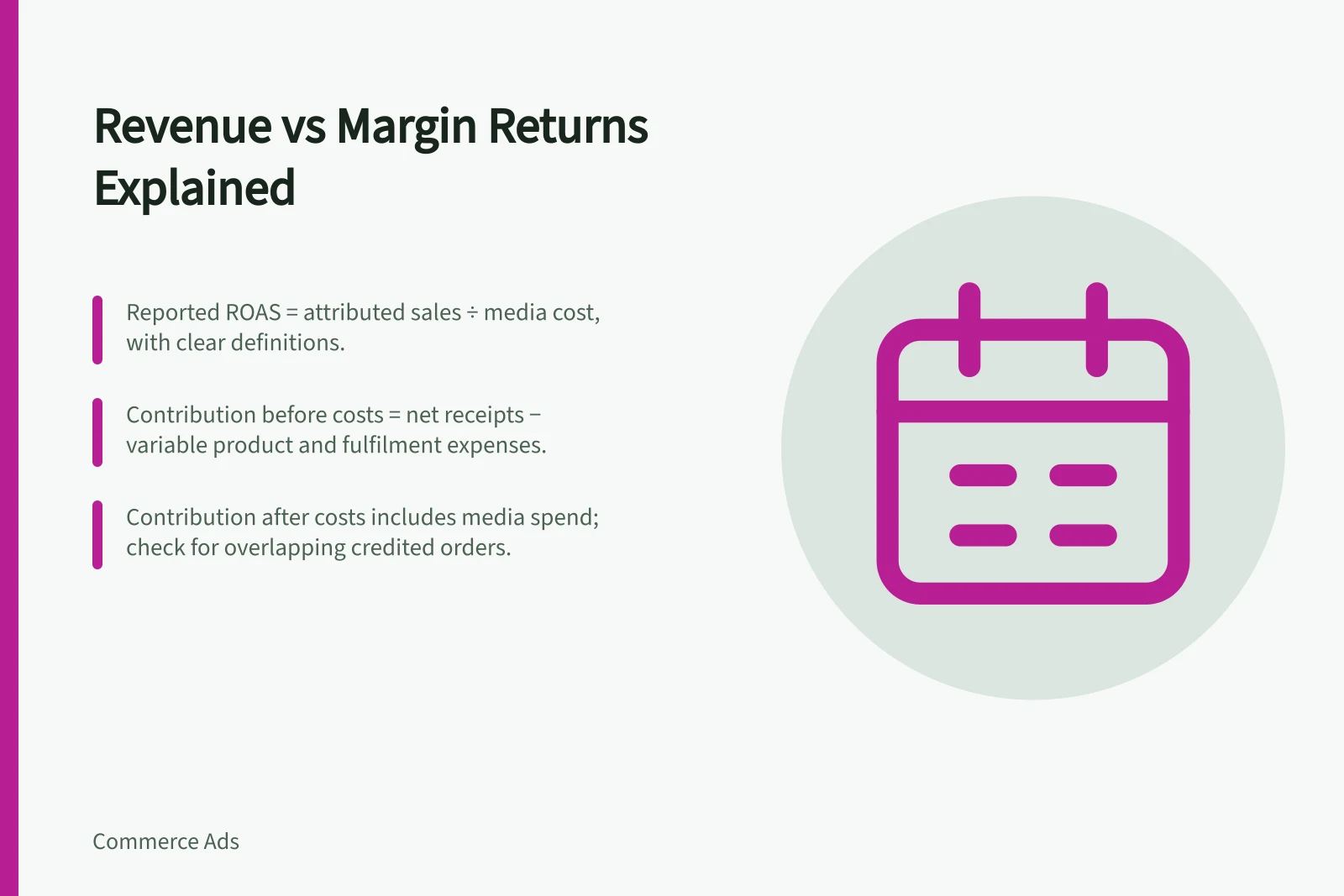
Write the revenue formula next to the result: Reported attributed-sales ROAS = attributed sales value ÷ included media cost.
State whether sales are gross or net, which products and channels count, whether credit follows clicks or views, the attribution window and which charges are outside media cost. The provider’s actual metric still needs its own definition.
Bridge to advertiser contribution
Bridge to advertiser contribution
For the same eligible orders and product set, use finance-approved receipts and costs:
Contribution before campaign costs = advertiser’s net receipts − variable product, transaction and fulfilment costs.
Contribution after campaign costs = contribution before campaign costs − media and other applicable campaign costs.
A useful margin-based comparison is contribution before campaign costs ÷ total included campaign costs, with the numerator, denominator and exclusions shown. Call it a contribution-to-cost ratio so it cannot be confused with the retailer’s sales ROAS. Also show the contribution left after those costs in pounds.
Place refunds, retailer fees and promotional allowances where the agreement and ledger place them. Do not subtract an allowance twice if it has already reduced net receipts. Keep fixed creative or data charges visible even when a platform excludes them from ROAS. Use the actual sales mix, or a stated assumption, when products have different margins.
For a hypothetical campaign, suppose a retailer credits £1,000 of net shopper sales and charges £200 in media. Reported sales ROAS is 5.0. Suppose the advertiser retains £650 on those credited orders, incurs £400 of variable costs and pays £50 of other campaign charges.
Contribution before campaign costs is £250; total included campaign costs are £250; the contribution-to-cost ratio is 1.0 and contribution after those costs is £0. The figures illustrate arithmetic, not a UK benchmark or measured result.
Compare on a consistent basis
Compare on a consistent basis
Show each retailer’s original ROAS beside its advertiser contribution bridge. Mark missing costs and transactions. Gross and net sales ratios should not be presented as equivalent. A different product mix can also change contribution even when media delivery is similar.
Do not average retailer ratios. If compatible sales and costs can legitimately be combined, divide total eligible sales by total included media cost. For the contribution view, sum eligible receipts and costs on a consistent basis before calculating a portfolio figure, and check for overlapping credited orders first.
Label the result as contribution associated with attributed orders, less the stated campaign costs. Those orders may have happened without advertising. A causal profit decision needs a credible estimate of additional contribution and its uncertainty. Without that evidence, use this bridge to describe commercial exposure and identify what to test next.