Incrementality Testing
Part of Measuring commerce advertising
New-to-brand customers and the limits of that metric
Learn what new-to-brand reports count, how customer history differs from attribution, and why the metric does not prove uplift.
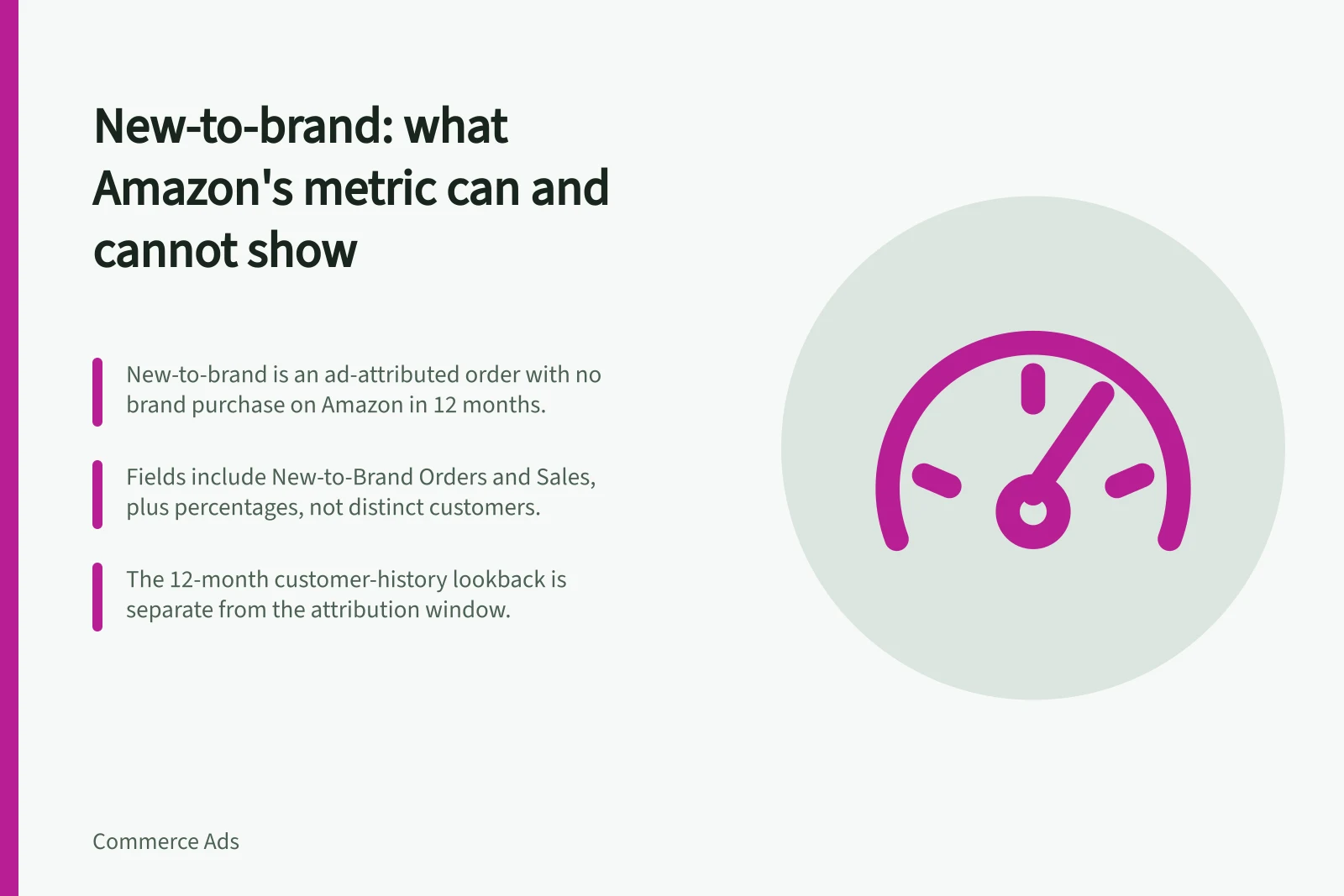
On Amazon, a new-to-brand order is an ad-attributed order by a shopper who has not purchased from the advertised brand on Amazon during the preceding 12 months. It describes observed orders within that marketplace and history period; it does not establish a first-ever purchase from the brand or prove that advertising caused the order.
How an order is classified new-to-brand
- An eligible advert interaction occurs1
- The shopper places an order within the attribution window2
- Amazon checks the shopper’s purchase history from the advertised brand on Amazon over the preceding 12 months3
- No qualifying purchase is observed, so the order is classified new-to-brand4
- If a qualifying purchase is observed in that period, the order is not new-to-brand5
Find out what ‘new’ means
Amazon’s named fields include “New-to-Brand Orders”, “% of Orders New-to-Brand”, “New-to-Brand Sales” and “% of Sales New-to-Brand”. The order percentage is new-to-brand orders divided by overall campaign orders; the sales percentage is the share of attributed revenue from new-to-brand purchasers. These are order and sales measures, not counts of distinct new customers.
In 2019, new-to-brand reporting was described as available for video and display ads on Amazon DSP, and for Sponsored Brands through Campaign Manager in Seller Central or Advertising Console in Vendor Central. Sponsored Products were excluded in that description.
Separate the two clocks
Amazon’s customer-history lookback is 12 months. A shopper whose previous Amazon purchase falls outside that period can qualify as new-to-brand; holding campaign orders fixed, a longer lookback can only leave or reduce the number and share classified as new, while a shorter one can only leave or increase them.
This purchase-history period is separate from an attribution window, which determines how long after an eligible advert interaction a purchase can receive credit.
Read the blind spots
The classification is based on purchases from the brand on Amazon, so it cannot rule out a purchase through another retailer or one made before the 12-month period. Purchases attached to identities Amazon cannot connect may also be absent from the observed history.
“No observed qualifying purchase on Amazon in the preceding 12 months” is more precise than “never bought the brand”. New-to-brand is a descriptive indicator, not proof of incremental acquisition: some shoppers classified as new may have bought without the advert.
What the metric shows and what it cannot show
- Observed orders from shoppers with no qualifying brand purchase on Amazon in the preceding 12 monthsShows
- Order and sales mix attributable to shoppers classified as new-to-brandShows
- A first-ever purchase from the brandCannot show
- Purchases made through another retailerCannot rule out
- Purchases made before the 12-month history periodCannot rule out
- Purchases attached to identities Amazon cannot connectCannot rule out
- That advertising caused the order or acquired a shopper who would not otherwise have boughtCannot show without a credible comparison
Use it for an acquisition decision
Report the field and its denominator together: distinguish the share of orders from the share of sales, and state the brand and 12-month history basis. Compare results only where the brand definition and observable sales population are sufficiently stable.
Use the result to describe the observed purchaser mix. To claim that advertising acquired shoppers who would not otherwise have bought, the outcome needs a credible comparison.
Reporting new-to-brand responsibly
- Report the field and its denominator together
- Distinguish the share of orders from the share of sales
- State the brand definition and the 12-month history basis
- Compare results only where the brand definition and observable sales population are sufficiently stable
- Use the result to describe the observed purchaser mix, not to assert causation
- Claim incremental acquisition only where there is a credible comparison