Incrementality Testing
Part of Retail media incrementality tests
Measuring whether ads shift sales between a brand's products
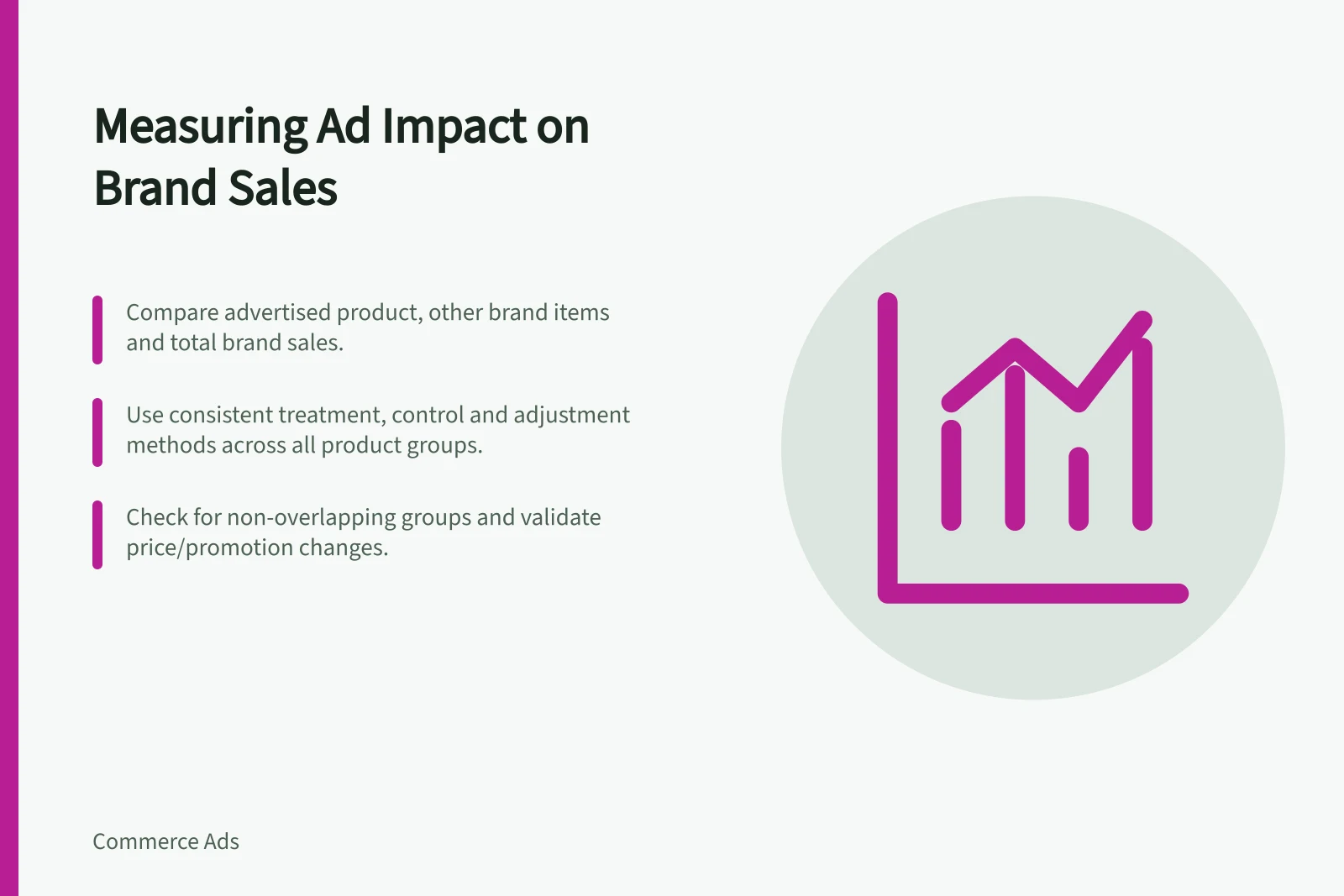
Compare advertised-product lift with other brand products and the brand total to assess possible switching in a retail media test.
An advertised product may gain sales while another from the same brand loses them. To gauge whether the campaign increased the brand’s sales within the measured retailer, compare the advertised product, other relevant brand products and a non-overlapping brand total in the same test. A promoted-item uplift alone does not reveal a shift within the range.
Fix the product sets first
List the advertised SKU and its variants, plausible substitutes from the same brand, and any other brand products the campaign might affect. Note how the retailer groups parent SKUs and variants. If the report includes a ‘halo’ figure, ask which items it covers and whether it already includes the advertised product. An attributed halo figure is not itself a causal estimate.
Choose the commercial question before reading outcomes. A new size might take sales from an existing size, leaving total brand units little changed. A move towards a higher-margin product might change contribution even if units do not rise. Assess contribution with the advertiser’s own receipts and costs.
Compare effects across the range
Use the same treatment and control assignment, period, channels and transaction rules for each product group. Calculate an effect for the advertised product, the other brand products and the brand total using the study’s planned method.
If groups have different numbers of eligible shoppers or stores, raw sales totals are not directly comparable; use a consistent denominator or the pre-specified adjustment.
This hypothetical example uses equal groups of 1,000 eligible shoppers:
| Mutually exclusive product group | Treatment units | Control units | Difference |
|---|---|---|---|
| Advertised product | 80 | 60 | +20 |
| Another brand product | 40 | 55 | −15 |
| Combined brand total | 120 | 115 | +5 |
The advertised product’s difference is larger than the brand total’s. The figures illustrate arithmetic, not a campaign finding or proof that particular shoppers switched products. An actual study also needs uncertainty for the brand-total effect and any product-level difference used in a decision.
Test the interpretation
Check that product groups do not overlap and that an order line is counted once in the brand total. Review price, promotions, stock gaps, new listings and discontinued items across groups. Opposing product effects are consistent with substitution, but they do not identify individual switching or establish causality if the comparison itself is weak.
Keep the conclusion within the retailer, observed products and study period. Sales might move to or from another retailer outside the study. If the brand-total estimate is uncertain, say so even when the advertised product’s estimate is positive. Use the result to choose what to test or feature next, with the net brand outcome and product economics visible.